A Delivery Leader’s Perspective on Engineering Discipline and Intelligent Acceleration
The Shift Nobody Announced
Nobody sent a memo. There was no all-hands meeting, no dramatic keynote moment. One day, software teams just started working differently — and the ones paying close attention noticed.
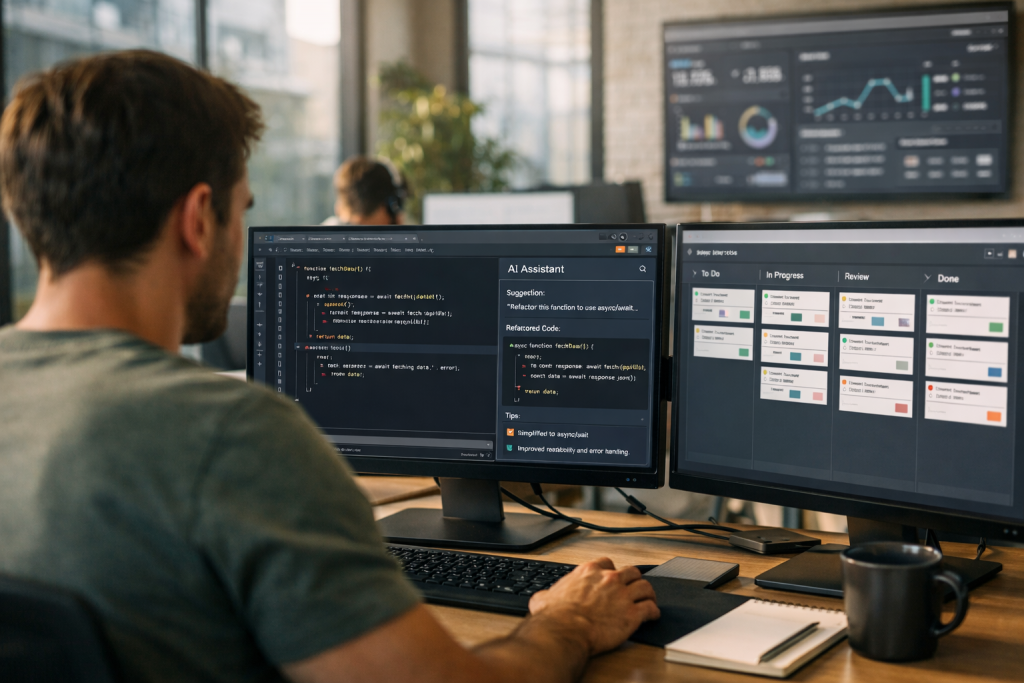
I’ve been managing delivery across SaaS platforms, ERP systems, automation tools, and client-facing products long enough to recognize when something is actually changing versus when people are just excited about something new. This is the real thing.
AI is no longer the assistant sitting politely in the corner. It’s joined the delivery team — and it’s surprisingly punctual.
The change isn’t showing up in blog posts first. It’s showing up in sprint velocity, release cycles, and the way engineers describe their day. That’s how you know it’s real.
And while other industries are still cautiously circling the pool, software development jumped in headfirst — because AI improves the very thing used to build AI. It’s a feedback loop with no off switch.
____________________________________
What Actually Changed (And What Didn’t)
For years, our delivery pipeline looked like a very reliable, very slow assembly line:
Requirement → Analysis → Design → Development → Testing → Deployment → Repeat
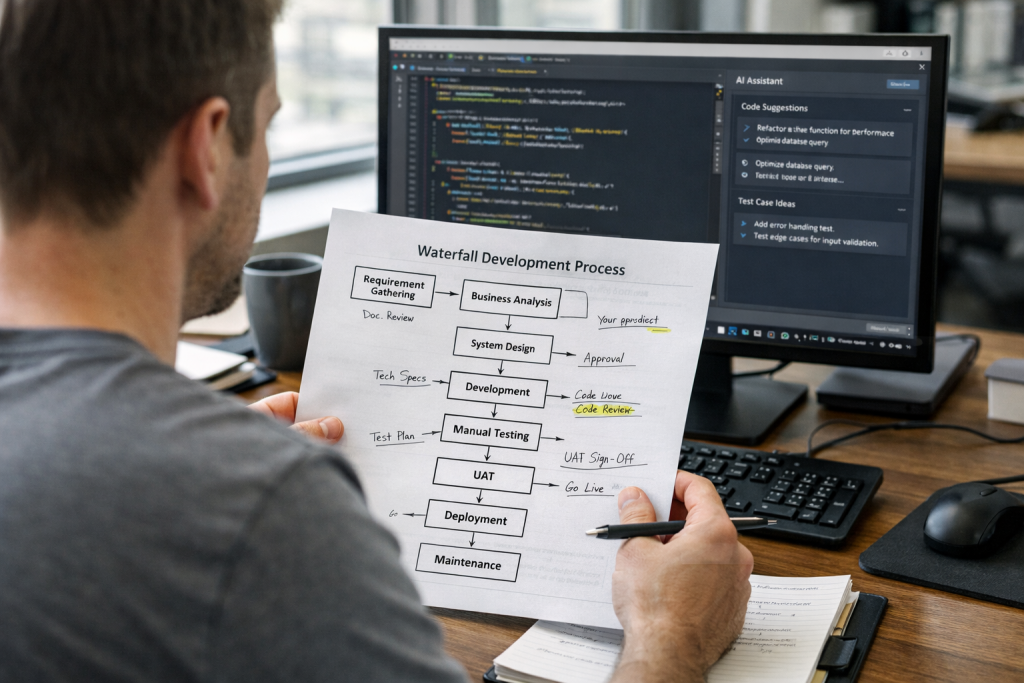
Each stage depended on a human manually doing The Thing.
Writing the logic. Drafting the docs. Creating test cases one by one. Debugging like a detective with too much coffee and too few clues.
Here’s what’s changed: many of those stages can now be accelerated. Not eliminated, just accelerated.
Think of it like getting a GPS. You still drive the car. You still make the turns. But you’re no longer squinting at a paper map in the rain.
Developers are shifting from writing everything from scratch to defining outcomes clearly. Instead of starting with a blank file and an existential stare, teams now:
- Generate structured baselines using AI, then refine them
- Validate outputs with human judgment and domain knowledge
- Spend more mental energy on architecture and decision-making
- Compress prototype and PoC cycles from weeks to days
The difference shows up in real numbers. Sprint velocity changes. Turnaround shrinks. Stakeholders stop wondering why simple things take so long. But — and this is important — none of this works without the humans staying in the loop.
___________________________________
What This Means If You’re in IT (Honest Version)
Let’s talk plainly for a moment, because I’ve had this conversation with enough junior developers to know the anxiety is real.
The entry-level tasks that used to fill the first two years of a software career:
Boilerplate code, Standard documentation, Repetitive test case creation, Basic data structuring
AI handles a large chunk of these now, and handles them fast.
This doesn’t mean your job disappeared. It means the job description changed. The bar moved.

Earlier, contribution meant completing assigned tasks reliably. That was enough. Now, contribution means understanding why the system works the way it does, being able to catch when an AI-generated output is subtly wrong, and thinking about the workflow, not just the next ticket.
Think of it like the calculator analogy. When calculators arrived, we didn’t stop needing people who understood math. We stopped needing people who could only do arithmetic. The role evolved upward. Same thing is happening here.
The professionals who will thrive aren’t the ones who use AI the most — they’re the ones who use it the most wisely.
___________________________________
Why Software Feels This Before Everyone Else
Here’s a fun bit of irony: AI was built using software, and now it’s being used to build better software, which will build better AI. It’s the world’s most productive ouroboros.
In regulated industries — healthcare, finance, legal — adoption moves slowly because compliance layers act as speed bumps. That’s not always a bad thing.
But in IT, if a new model improves productivity today, a good engineering team can be using it by next week.
That agility is a competitive advantage. It’s also pressure. Teams that don’t adapt don’t just fall behind philosophically — they fall behind on delivery timelines, client expectations, and market competitiveness. In service-based IT, those things have very direct consequences.
__________________________________
How We’re Approaching This at Summitcode
We work across a wide range of industries and delivery environments. Some projects demand strict architectural control. Some require compliance-heavy workflows. Some need deep domain expertise where you absolutely cannot shortcut your way through.
So our approach wasn’t “roll out AI everywhere and see what breaks.” That’s a great way to build fast and break trust.
Our philosophy: Engineering discipline strengthened by AI acceleration. Not replaced by it.
In practice, that looks like this:
- Accelerating boilerplate and repetitive development tasks — the stuff nobody enjoys writing anyway
- Faster PoC and prototype cycles, so clients can see and react to real things sooner
- AI-assisted test case structuring, always with human validation layered on top
- Documentation refinement — because nobody reads documentation that was painful to write
- Intelligent debugging support that helps engineers triangulate problems faster
- Workflow automation embedded into the SDLC, not bolted on as an afterthought
- Senior-level review on every AI-generated output — always
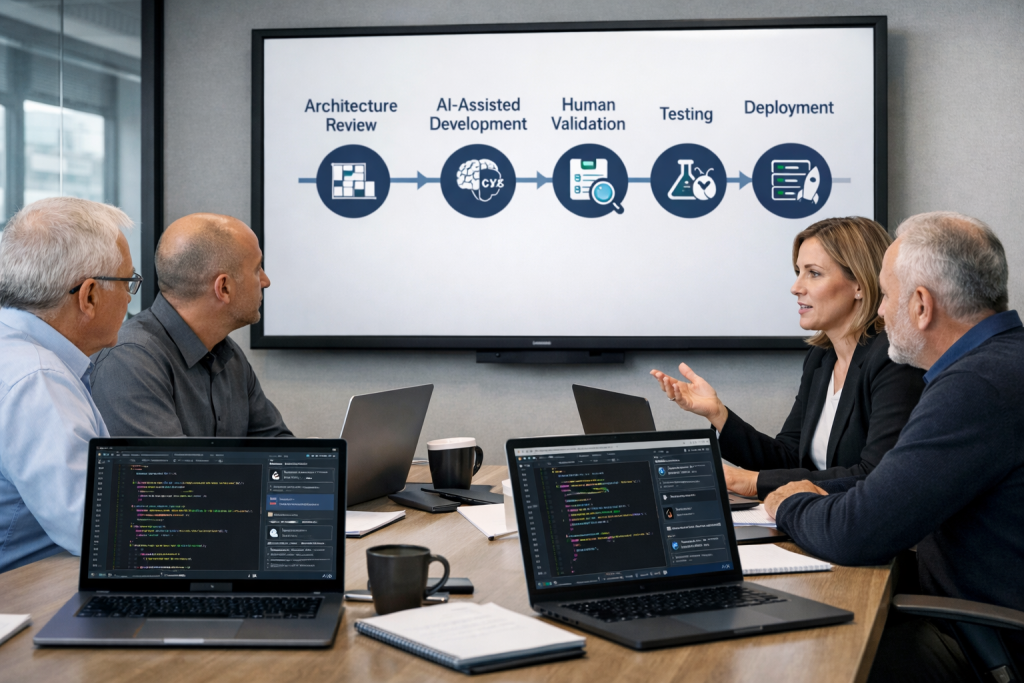
We haven’t removed accountability from the equation. We’ve just given the team better tools to work with. The engineering maturity has to come first.
AI amplifies what’s already there — good habits and bad ones alike.
___________________________________
What I Tell Freshers Who Ask Me About This
I get this question a lot now, usually from developers who are six months into their first role and already reading headlines about automation. Here’s what I actually tell them:
Stop worrying about whether AI will replace you and start thinking about how to make yourself the kind of engineer who works effectively alongside it. Because that’s the only version of this question that matters for your career.
Concretely, focus on:
- Understanding systems, not just syntax. Know why the architecture is the way it is.
- Developing architecture thinking. The people who design systems are not going anywhere.
- Validating AI outputs critically. AI is confident even when it’s confidently wrong.
- Learning to prompt clearly and precisely. It’s a real skill, not a party trick.
- Thinking in workflows and outcomes, not isolated tasks.
AI won’t replace strong engineers. But engineers who understand how to leverage AI will consistently outperform those who don’t.
That gap is already visible in delivery environments today.
___________________________________
Questions for Delivery Leaders and Founders
If you’re running a software team, here’s a short diagnostic worth sitting with:
- Are your teams AI-enabled responsibly, or just AI-adjacent?
- Are you training people to validate and question outputs — or to blindly paste and ship?
- Have you updated your productivity benchmarks, or are you measuring AI-assisted work with pre-AI expectations?
- Is AI integrated into your SDLC with intention, or just casually sprinkled on top?

In service-based IT, time-to-market and quality directly affect how competitive you are.
The teams that adapt early and adapt thoughtfully will consistently deliver faster without sacrificing standards. The teams that delay will find themselves wondering why everything takes so long.
___________________________________
Final Thought
This isn’t about hype. Hype burns out. This is about a genuine operational shift that’s already in progress, and the question is only whether your team is ahead of it, in the middle of it, or about to be surprised by it.
At Summitcode, we’re not replacing engineering fundamentals. We’re strengthening them with intelligent acceleration.
The fundamentals are the foundation. AI is what lets you build faster on top of a solid one.
For anyone building a career in IT right now: this is exactly the right time to evolve from task executor to solution orchestrator. The window is open. Step through it.
____________________________________
Key Takeaways
- AI is reshaping execution inside software delivery — not in the future, right now
- Engineering fundamentals remain non-negotiable; AI amplifies them, not replaces them
- AI-first doesn’t mean AI-only. Human judgment is still the most important input
- IT professionals who thrive will be orchestrators, not just executors
- Responsible AI integration improves speed without compromising quality — but only when done deliberately