When the System Breaks, He Finds the Seam
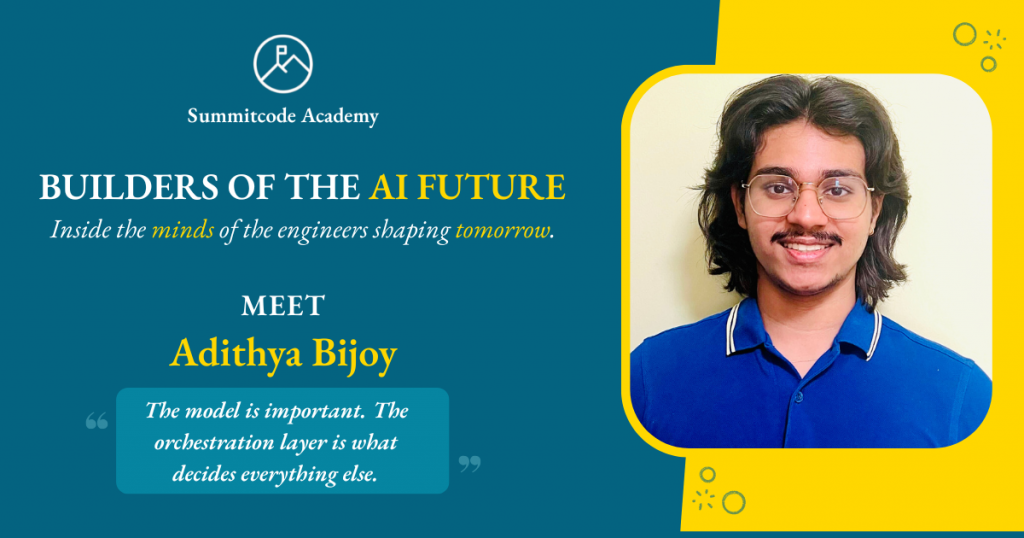
Meet Adithya Bijoy, the engineer who stopped patching symptoms and started redesigning the architecture.
At most internships, a bug is something you fix and move on. For Adithya Bijoy, bugs are diagnostic signals — evidence that the system beneath isn’t quite right yet. That instinct, to look past the symptom and find the structural failure, is what makes him stand out as one of SummitCode’s most promising AI engineering interns.
Adithya is currently in his fourth year at VIT-AP University, pursuing a B.Tech in Computer Science with a specialisation in Cyber Security. Before joining the SummitCode AI Engineering Internship, he had already built a DPI firewall, a network monitoring dashboard, and a proxy rotation system with geo-targeting — projects that taught him to think about failure as a feature, not an afterthought.
“I spent a lot of time thinking about failure cases,” he says. “What happens when data is messy, when parts of the system break, or when traffic spikes in ways you didn’t plan for.”
That habit of stress-testing assumptions brought him here — to Wordiva.
What is Wordiva?
Wordiva is an AI-powered content marketing system built as a pipeline of specialised agents, each handling a distinct part of the content creation process: research, strategy, writing, media, and review. Rather than relying on a single model with a single prompt, the work is intelligently distributed — and human review checkpoints are built into the flow to keep outputs grounded and trustworthy.
Adithya is one of the core engineers building this system as part of SummitCode’s AI Engineering Internship, working at the intersection of the Academy and the Venture Studio.
“It’s meant for people or teams who need to produce content regularly but struggle with either consistency or time,” he explains. “A lot of content tools give you full automation with no control, or full control with no scalability. Wordiva sits somewhere in between.”
The idea is modularity: you can see what’s happening at each stage, adjust individual components, and trust the output more than you would from a single-prompt system. It’s a product philosophy that mirrors how Adithya approaches engineering itself — in visible, testable, replaceable pieces.
The problem that forced real engineering
Ask Adithya what his hardest challenge has been, and he doesn’t hesitate: getting agents to reliably communicate with each other.
“It starts simple,” he says, “but once you have multiple steps in a chain, small format issues start breaking things downstream in annoying ways. One agent outputs something slightly off, and suddenly two steps later the entire flow degrades in a way that’s not obvious to debug.”
His solution was a reframe. Instead of treating it as “LLMs talking to each other,” he started treating each agent as a strict service boundary — with explicit input/output schemas, validation at every handoff, and prompts designed not just to describe but to constrain.
“I also introduced small feedback loops so that if something looks off early, it gets caught before propagating. That helped shift the system from something fragile and unpredictable into something I could reason about step by step.”
This is what separates junior engineers from those who are genuinely ready to build production systems: the ability to change the frame, not just the fix.
The moment it clicked
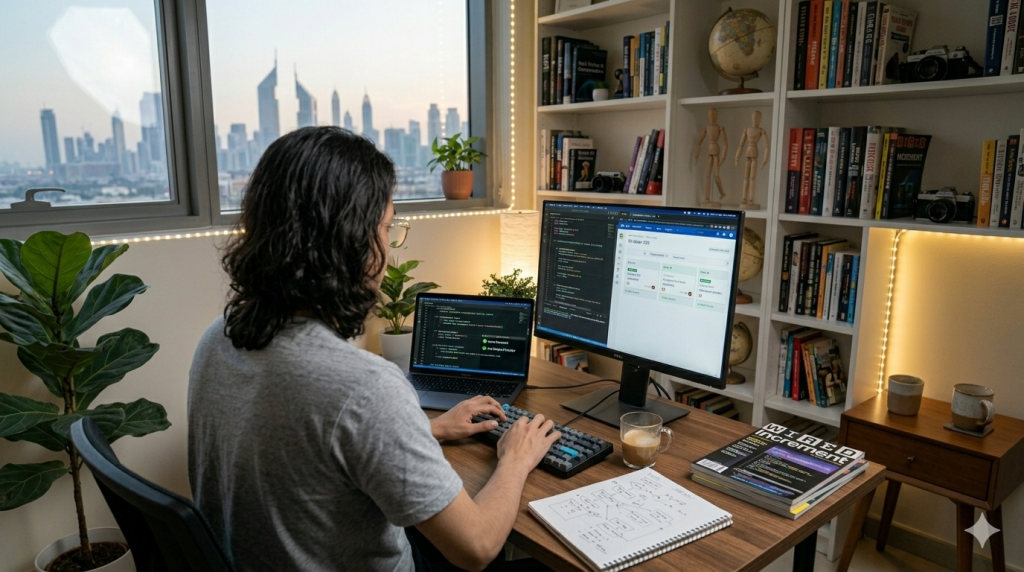
There’s a specific moment Adithya points to when asked what made him feel like a real engineer on this project.
Outputs between the research and writing agents kept drifting in quality. He tried several small fixes. The problem kept returning. Eventually he realised the issue wasn’t in the agents themselves — it was in the interface between them.
“I stepped back and reworked that boundary properly: stricter formats, better validation, tighter prompts, and clearer expectations on both sides. Once that changed, the instability mostly disappeared.”
It’s a quiet but significant insight. The model wasn’t the problem. The contract between components was. And fixing the contract fixed the system.
“What made it stand out for me wasn’t just that it worked — it was the way I approached it. Instead of continuing to patch symptoms, I had to zoom out, identify the structural issue, and make a deliberate design decision. That felt closer to how real engineering problems are actually handled.”
What surprised him most
Adithya came in expecting better models to mean better outcomes. What he found was more interesting — and more transferable.
“The biggest gains came from how the system was designed. The way you break down tasks, how you structure context, and how strict you are about interfaces between components has a much bigger impact than I expected. The model is important, but the orchestration layer is what decides whether the system is stable or chaotic.”
This is an insight that many engineers arrive at much later in their careers — if at all. The fact that Adithya is drawing this conclusion while still in university speaks to the kind of environment the SummitCode internship creates: one where you can’t rely on the tool to save you. You have to understand the system.
The environment
When asked about the programme itself, Adithya describes something that will resonate with any engineer who has been burned by both micromanagement and total ambiguity.
“There’s structure, but not the kind that boxes you in. I get feedback when I need it, but there’s also room to try things and sometimes mess them up.”
That balance — independence with direction, collaboration without handholding — is exactly what strong engineers need to grow. And it’s what SummitCode’s internship is designed to provide.
Advice for anyone considering applying
Adithya doesn’t oversell it, which is exactly why you should listen.
“If you want to understand how AI systems actually work beyond just calling APIs and getting responses, this is a good place for it. But it’s not a ‘follow instructions’ kind of internship. You have to be curious enough to dig into problems yourself, because a lot of what you’ll work on won’t come with a clear checklist or predefined solution.”
And then, the line that says everything about who he is: “You’ll be expected to figure things out, ask the right questions, and sometimes define the problem as much as solve it.”
If that sounds interesting instead of exhausting — you might be exactly who we’re looking for.
Applications for the SummitCode AI Engineering Internship are open. Learn more at summitcode.pro/ai-engineering-internship Explore what we’re building at wordiva.ai
🎬 Watch Adithya Tell It Himself →
"The model is important. The orchestration layer decides everything else."
— SummitCode (@SummitCodeLLC) April 29, 2026
Meet Adithya — building @wordivaai , a multi-agent AI content system, at SummitCode Academy while still in university.
Watch the reel 👇
#AgenticAI #BuildInPublic #SummitCode #Wordiva #Bootcamp pic.twitter.com/0wnCnxHYo3