Not every engineer arrives through the front door.
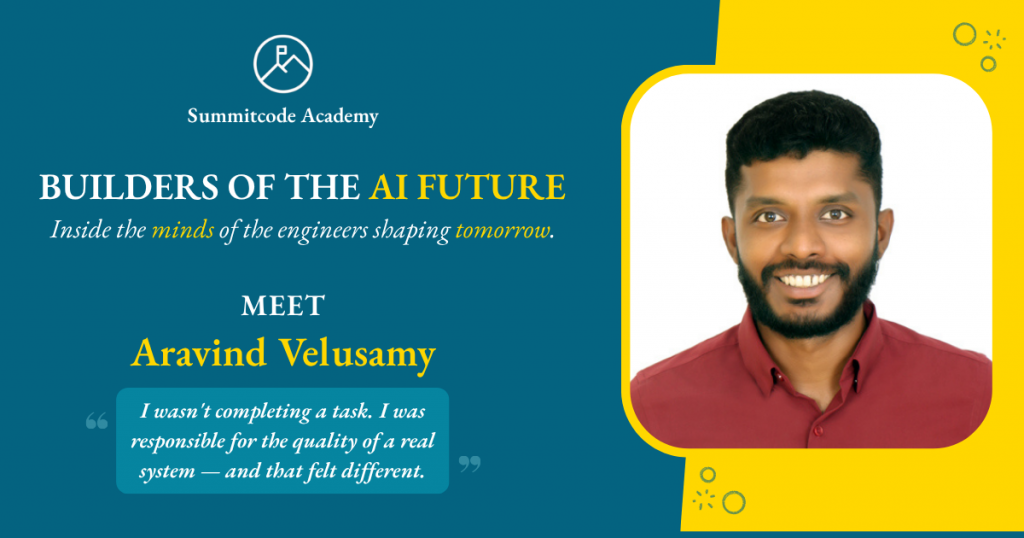
Aravind Velusamy has a chemical engineering degree, five years of experience as a data analyst, and a growing certainty that the work he was doing — however good he was at it — wasn’t the work he wanted to be doing anymore.
He wasn’t a computer science graduate. He wasn’t a fresh-faced student. He was a professional, mid-career, staring at the edge of a field he knew was transforming everything around him — and deciding to jump.
What happened next is one of the most honest accounts of what it actually takes to reinvent yourself as an AI engineer.
Before SummitCode: Close, But Not Quite There
Aravind’s pre-SummitCode resume is impressive by any measure. Python, SQL, Power BI, machine learning — five years of turning raw data into insight, building dashboards that executives actually used, and automating processes that used to take teams of people hours to complete.
But something was missing.
“Over time I realized I wanted to stop just analyzing systems and start building intelligent ones,” he explains. “I kept seeing AI transforming industries and felt like my skillset was sitting right at the edge of it — close, but not quite there.”
That phrase — close, but not quite there — captures a feeling that thousands of data professionals know intimately. You understand the data. You understand the models. But the leap from analyzing AI outputs to building the systems that produce them is wider than it looks from the outside.
Aravind decided to close that gap. Not with another online course. With a real project.
“I wanted to make the jump from data analyst to AI engineer, and I needed a real project to do it — not another course.”
The Path In: An Unusual Route to an Uncommon Skill

After researching what a genuine transition into AI engineering would actually require, Aravind found what he was looking for — not another theoretical programme, but a real product environment where the learning happened through building.
“When I looked into it, it genuinely excited me,” he says. “This bootcamp felt like the bridge between where I was and where I wanted to go.”
That word — bridge — matters. Aravind didn’t need to start from scratch. He had five years of Python fluency, deep familiarity with data pipelines, and the kind of systems thinking that chemical engineering beats into you early. What he lacked was the architecture knowledge to take that foundation and build something autonomous, intelligent, and production-ready.
SummitCode gave him the project to do it.
The Product: An AI That Actually Knows Your Brand
Ask Aravind to explain Wordiva.ai and he doesn’t reach for jargon. He reaches for the clearest possible picture.
“Imagine a smart assistant that actually understands your brand — not just your tone of voice, but your values, your audience, your goals — and then autonomously plans, creates, and publishes content across formats. Text, images, even video.”
Built at the SummitCode Venture Studio, Wordiva is an Agentic AI Content Marketing System designed for businesses producing high volumes of content who struggle with consistency, speed, and the mounting cost of doing it manually. Crucially, it isn’t a black box — a structured human review layer means a real person approves content before anything goes live.
What makes it technically compelling, in Aravind’s view, is the RAG component — the system that grounds everything the AI generates in actual brand knowledge, so the output doesn’t just sound like good marketing copy. It sounds like your marketing copy.
“What makes it genuinely interesting technically is the RAG component, which grounds everything the AI generates in actual brand knowledge — so the output feels like it came from inside the company, not from a generic model.”
The Hard Problem: Learning to See the Whole System
For someone who’d spent five years working within data pipelines — pull data, build report, present findings — the challenge of Aravind’s first weeks at SummitCode wasn’t any single technology. It was the architecture itself.
“Coming from a data analyst background, I was comfortable working within a pipeline — but here I had to understand how every piece connects: how Celery handles async jobs, how the RAG module feeds context into the agent, how Streamlit sits on top of all of it as the review interface. It was overwhelming at first.”
His solution was deceptively simple: he talked through it. Peer programming with teammates, drawing out data flows on paper, asking “why does this component exist?” rather than just “how does it work?”
“Slowly the whole picture clicked.”
That shift — from understanding individual tools to understanding why a system is designed the way it is — is the leap that separates analysts from engineers. Aravind made it through conversation, curiosity, and sheer persistence.
The Breakthrough: When RAG Changed Everything

Of all the technologies Aravind encountered in the internship, one genuinely surprised him: Retrieval-Augmented Generation.
As a data analyst, he understood databases. He understood search. But the idea that you could dynamically inject retrieved context into a language model at inference time — making it brand-aware, factually grounded, and specific — was something he hadn’t imagined.
“It felt like the missing link between structured data work — which I knew — and generative AI — which I was learning.”
RAG is now, by his own admission, the part of the project he enjoys most. And that makes sense: it’s the technology that sits precisely at the intersection of everything Aravind already knew and everything he came to SummitCode to learn.
The Moment It Became Real
There’s a specific moment Aravind returns to when asked what it felt like to stop being an intern and start being an engineer.
The RAG pipeline was technically working. Chunks were returning. The LLM was generating content. But the output felt generic — coherent, but not brand-specific. Most people would have accepted it and moved on.
Aravind didn’t.
“I stopped and asked why. I started tracing how the context was being injected, questioned our chunking strategy, tested different retrieval approaches with my teammates.”
“That debugging process — not waiting for someone to tell me what was wrong, but owning the problem and reasoning through it systematically — that’s when it stopped feeling like an assignment. I wasn’t completing a task. I was responsible for the quality of a real system, and that felt different.”
That is the sentence that defines Aravind’s transformation at SummitCode. Responsible for the quality of a real system. Not a student submitting coursework. An engineer who owned the outcome.
The Unexpected Advantage of an Unusual Background
Here’s what makes Aravind’s story genuinely instructive for anyone who thinks their background isn’t the right fit for AI engineering.
His chemical engineering degree didn’t hold him back. It gave him something most CS graduates don’t have: systems thinking baked in at a foundational level. Process design. Bottleneck analysis. Optimization across interconnected components. Those instincts transferred directly into understanding distributed AI architecture.
His five years in data analytics didn’t hold him back either. They gave him Python fluency, ML literacy, and the ability to reason about data quality — skills that turned out to be essential for building a production RAG system.
“I have an unusual background — chemical engineering, 5 years in data analytics, now building agentic AI systems. That combination is actually rare and valuable. Most AI engineers come purely from CS; I bring domain problem-solving, data expertise, and now hands-on experience with production AI architecture.”
The doors he now sees opening aren’t just standard AI engineering roles. They extend into AI product development, and into applying agentic AI to industries — manufacturing, energy, chemical processing — where almost no one with his specific combination of skills currently exists.
The Environment: Thinking Out Loud as a Professional Practice
In his data analytics career, Aravind mostly worked alone. Pull the data. Build the report. Present it. Repeat.
SummitCode changed that fundamentally.
“The peer programming has been invaluable. Thinking out loud with teammates while building is completely normal here — and it accelerated my learning dramatically.”
The mentors, he notes, operate the same way — pushing interns to reason through problems rather than simply receiving answers. It’s uncomfortable, he admits. But it’s the discomfort that produces genuine understanding rather than surface-level familiarity.
His Message to the Unconventional Candidate
Aravind’s message isn’t aimed at the typical CS graduate. It’s aimed at a very specific person — the career-changer, the analyst, the domain expert from another field who suspects AI might be their next chapter but can’t quite see the path in.
“The hesitation you feel is exactly why you should apply.”
“I came from chemical engineering and data analytics — I wasn’t a typical AI candidate. But that background didn’t hold me back; it actually gave me a different perspective that made me more useful on the team.”
And then the line that cuts straight to the heart of it:
“Do you want to keep watching AI happen — or do you want to be one of the people building it?”
Aravind Velusamy is an AI Engineering Intern at SummitCode, contributing to Wordiva.ai — an AI Content Marketing Agent built at the SummitCode Venture Studio.
Ready to make the jump? Explore the SummitCode AI Engineering Internship →