The software engineering discipline is currently undergoing a structural and economic metamorphosis unparalleled since the transition from punch cards to high-level procedural programming languages. For decades, the fundamental paradigm of software creation has remained relatively static: human operators manually translate abstract business logic into rigid syntactic structures, which compilers then translate into machine execution. This traditional model is rapidly dissolving, replaced by an expansive ecosystem where artificial intelligence generates, tests, refines, deploys, and observes computational solutions. This transformation necessitates a comprehensive reevaluation of industry standards, organizational structures, and the foundational definition of engineering competency.
The analysis presented herein explores the architecture of this profound transition through the framework of the five levels of AI-driven development. By superimposing these evolutionary levels onto progressive engineering competency models—such as the highly regarded and meticulously structured matrix developed by CircleCI—it becomes possible to trace the evolving trajectory of technical careers. Furthermore, the broader macroeconomic and structural implications of this shift, ranging from the theoretical “Macrohard” concept of direct binary generation championed by emerging AI initiatives to the highly tangible rise of the hyper-leveraged, one-person technology enterprise, reveal an industry moving inexorably toward infinite operational leverage and a zero marginal cost of production.
The Blueprint of Transformation: The Five Levels of AI-Driven Development
To thoroughly understand the current and future state of software engineering, it is absolutely essential to categorize the progression of artificial intelligence within the software development lifecycle. Modeled conceptually after the Society of Automotive Engineers (SAE) levels of autonomous driving, the five levels of AI-driven development provide a rigorous taxonomy for measuring machine autonomy in the creation and maintenance of software. This framework moves from complete human dependence to absolute machine autonomy, mapping the trajectory of an industry in flux.
Level 0: The Artisan Era (Zero Autonomy)
Level 0 represents the traditional, pre-AI baseline of software development, a methodology that has defined the industry for the past half-century. In this state, human engineers are entirely responsible for the arduous translation of business logic into precise syntax, the manual configuration of development environments, the orchestration of complex deployments, and the forensic debugging of runtime errors.
The tools utilized at this level are strictly deterministic in nature. Compilers, linters, static analyzers, and traditional integrated development environments (IDEs) operate solely on predefined, hardcoded rules. They possess no capacity for inference, contextual understanding, or generative output. In this paradigm, engineering productivity is linearly constrained by human cognitive bandwidth, working memory capacity, and sheer typing speed. The process is artisanal, requiring deep, esoteric knowledge of syntax and system architecture. At Level 0, scaling a software product inevitably requires scaling the human engineering headcount, leading to massive organizational bloat and communication overhead.
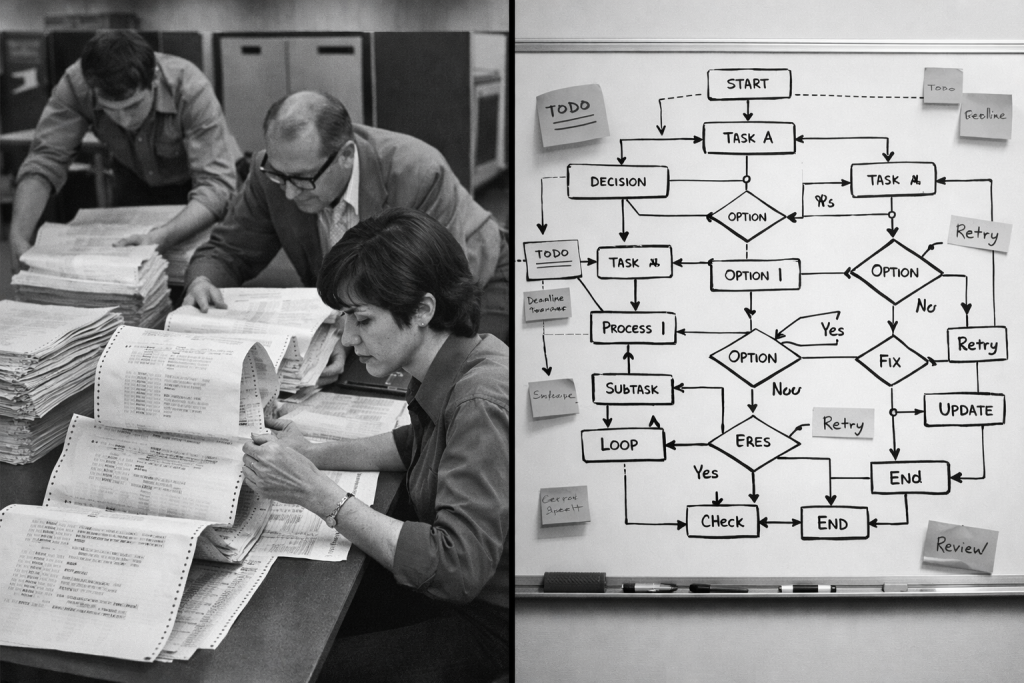
Level 1: The Copilot Era (AI Assistance and Syntax Augmentation)
The broader software industry currently operates primarily at Level 1, an era characterized by inline artificial intelligence assistance. At this stage, the AI functions not as an autonomous agent, but as an eager, highly capable, and encyclopedic intern peering over the engineer’s shoulder. It provides context-aware autocomplete functionalities, suggests extensive blocks of boilerplate functions, and can rapidly generate short, localized scripts based on natural language prompts.
Crucially, however, the AI at Level 1 lacks agency, long-term memory, and persistent architectural context. The human engineer remains absolutely in the driver’s seat, steering the broader system architecture, making all crucial semantic decisions, and rigorously reviewing the AI’s output for hallucinations, inefficiencies, and security vulnerabilities.
While enterprise productivity metrics frequently indicate significant gains at this level—often measured in double-digit percentage decreases in time-to-completion for discrete, isolated tasks—the fundamental software development lifecycle (SDLC) remains essentially unchanged. The human still writes the ticket, creates the branch, initiates the prompt, accepts the code, writes the tests (or prompts for them), and orchestrates the deployment. The AI reduces the friction of syntactic generation, but it does not redefine the overarching developmental process.
Level 2: The Agentic Era (Bounded Task-Level Autonomy)
Level 2 introduces a monumental shift: bounded, task-level autonomy. In this tier, the artificial intelligence evolves from a passive inline assistant reacting to keystrokes into a delegated, active agent capable of executing distinct, heavily scoped tasks. An engineer operating at Level 2 can assign a well-defined Jira ticket or a GitHub issue directly to an AI agent. The agent will then autonomously navigate the repository, clone the codebase, analyze the dependencies, draft the necessary architectural modifications, write the code, generate the corresponding unit and integration tests, and submit a complete pull request for human review.
Managing a Level 2 AI system requires a subtle but profound shift in core engineering discipline. It becomes less akin to writing complex logic and more akin to writing exhaustive, foolproof specifications for a junior developer who possesses infinite syntactic knowledge but zero intrinsic business context. The human’s role elevates sharply to that of a senior reviewer, an editor, and an orchestrator. The primary engineering bottleneck shifts from code generation to code validation. If the human reviewer cannot process and validate the influx of AI-generated pull requests at the speed they are created, the development pipeline clogs, exposing the limitations of human cognitive bandwidth in an agentic workflow.
Level 3: The Architect Era (System-Level Autonomy and Multi-Agent Orchestration)
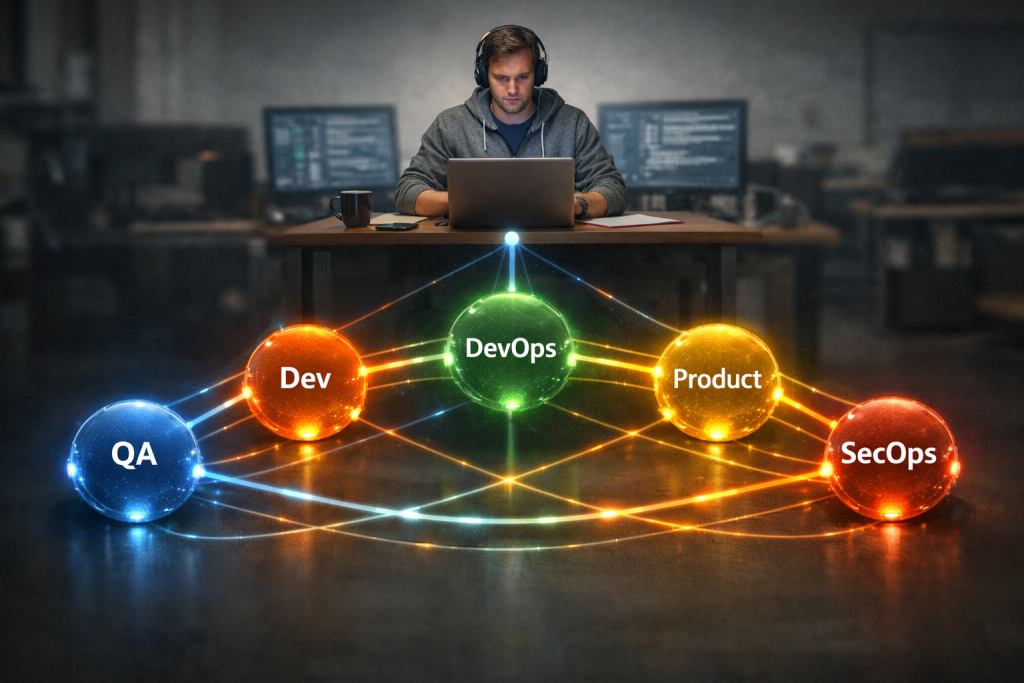
At Level 3, the paradigm of multi-agent systems fully emerges, marking the beginning of the end for traditional engineering team structures. It is no longer a scenario of a single AI assisting a single human developer; rather, it is a coordinated, communicative network of specialized AI agents acting cohesively as an autonomous engineering department.
In this architecture, one specialized agent handles product management (ingesting user feedback and translating overarching business requirements into granular technical specifications). Another agent acts as the system architect, designing the database schema and microservice boundaries. A swarm of developer agents executes the coding in parallel, while an adversarial QA agent continuously generates edge-case tests to break the code before it reaches production.
In this environment, human engineers act almost entirely as technical directors and system orchestrators. The AI takes the lead on generating entire modules, services, or overarching infrastructural changes. The human intervenes only at critical architectural junctures, during complex stakeholder negotiations, or when the multi-agent system encounters an unresolvable logical conflict.
It is at Level 3 that traditional Agile methodologies begin to fundamentally break down. Executing a two-week “sprint” with daily stand-ups becomes mathematically absurd when a multi-agent system can iterate through an entire sprint backlog, test it, and deploy it to a staging environment in a matter of hours. The cadence of development shifts from cyclical sprints to continuous, high-velocity flow.
Level 4: The Autonomous Lifecycle (End-to-End Product-Level Autonomy)
Level 4 represents the theoretical threshold of end-to-end commercial autonomy. An artificial intelligence system operating at this advanced tier can ingest a high-level, abstract business objective—such as “Build a highly scalable, decentralized application for peer-to-peer micro-lending with automated KYC compliance and dynamic interest rate generation”—and independently research, architect, code, test, deploy, monitor, and optimize the entire platform.
Crucially, a Level 4 system possesses the capacity to self-heal. It continuously observes production telemetry, and upon detecting a memory leak, a security vulnerability, or a logical error, it dynamically responds by isolating the issue, writing a patch, running a regression test suite, and deploying the fix without requiring human intervention.
At this stage, the human role shifts entirely away from code, infrastructure, and technical architecture. The focus of the human operator moves exclusively toward market strategy, ethical oversight, capital allocation, user acquisition, and the definition of organizational values. The AI ceases to be a tool used by the engineering department; the AI is the engineering department in its entirety.
Level 5: The Post-Code Era (Direct Hardware Execution and the Singularity)
Level 5 represents the absolute theoretical endpoint of AI-driven development: total AI autonomy, resulting in the complete obsolescence of human-readable code. At this apex, the AI does not translate business concepts into Python, Rust, or C++ simply to be reviewed by humans before compilation. It directly manipulates computational environments, optimizing algorithmic logic at the raw hardware and binary level.
The AI designs dynamic algorithms that are fundamentally beyond human cognitive capacity to parse, debug, or understand. It operates at a level of mathematical and physical optimization that renders traditional software engineering concepts—like clean code, object-oriented design, or microservice architecture—completely unrecognizable and irrelevant. This level achieves continuous, infinite iteration, fundamentally altering the limitations of what computational systems are capable of achieving, and paving the way for concepts like direct binary generation.
To synthesize the progression of these levels, the following table outlines the shifting responsibilities between human engineers and artificial intelligence systems across the developmental spectrum.
| Autonomy Level | Stage Name | Human Responsibility | AI Responsibility | Core Bottleneck |
| Level 0 | The Artisan Era | 100% of architecture, syntax, testing, and deployment. | None. Operates only as deterministic tools (compilers). | Human typing speed and working memory. |
| Level 1 | The Copilot Era | System design, logic formulation, prompt creation, rigorous review. | Inline syntax completion, boilerplate generation. | Human validation speed and prompt precision. |
| Level 2 | The Agentic Era | Scoping tasks, reviewing complete PRs, defining constraints. | Autonomous execution of isolated Jira tickets/issues. | Multi-agent coordination and integration conflicts. |
| Level 3 | The Architect Era | Technical direction, conflict resolution, business alignment. | Multi-agent collaboration, architectural design, parallel coding. | Alignment of AI output with vague commercial goals. |
| Level 4 | The Autonomous Lifecycle | Strategy, capital allocation, market positioning. | End-to-end SDLC, continuous deployment, self-healing. | Hardware limitations and API compute costs. |
| Level 5 | The Post-Code Era | Abstract objective setting. | Direct binary generation, hardware-level algorithmic optimization. | Physical limits of computation and energy. |
Redefining Engineering Competency: The CircleCI Matrix in the AI Era
As the technology industry rapidly traverses these five levels of autonomy, the traditional metrics and frameworks used to evaluate engineering talent must radically adapt. Historical engineering competency matrices frequently measured value through raw output and local optimization: the number of lines of code committed, the velocity of story points burned down per sprint, or the arcane complexity of an algorithmic implementation.
CircleCI’s extensively redesigned engineering competency matrix provides a highly instructive, modern baseline for how progressive, forward-thinking organizations view talent evaluation and career progression. The matrix explicitly separates the Individual Contributor (IC) track from the Management track, emphasizing that technical seniority does not necessitate people management. Instead, it measures seniority through outcomes, strategic impact, and organizational leverage over mere syntactic execution.
The CircleCI matrix organizes competencies into distinct, measurable pillars: Execution, Delivery, Teamwork, Communication, and Strategic Thinking. Analyzing how these specific competencies mutate under the immense pressure of AI-driven development (specifically transitioning into Levels 2, 3, and 4) reveals the definitive blueprint for the future software engineer.
The Evolution of Execution and Delivery: From Syntax to Orchestration
In a pre-AI world (Level 0) or an early AI-assisted world (Level 1), the competency of “Execution” is heavily tethered to technical depth and syntactic fluency. It implies a deep mastery over specific languages and frameworks (e.g., React, Go, Kubernetes), the ability to write highly performant, maintainable code, and the capacity to manually debug complex, deeply nested logical errors.
However, as organizations aggressively advance toward Level 2 and Level 3 autonomy, the market value of pure syntactic mastery plummets exponentially. When an AI agent can write syntactically perfect, optimized Rust or Python in seconds, the definition of “Execution” transitions from the creation of code to the orchestration of intelligence.
For a modern engineer, executing a complex project no longer means spending weeks writing boilerplate infrastructure or scaffolding microservices. Instead, Execution becomes the rigorous, highly intellectual practice of constraint engineering. It involves defining precise boundary conditions, establishing rigorous test-driven development (TDD) frameworks that the AI must satisfy, and validating the output of autonomous agents against overarching business logic.
Similarly, the competency of “Delivery” transitions fundamentally. Historically, Delivery meant successfully navigating brittle CI/CD pipelines, managing technical debt, and ensuring on-time feature deployment. In an AI-driven paradigm, Delivery morphs into evaluating whether the AI-generated architecture actually solves the user’s underlying problem. It involves managing the speed of the AI, ensuring that the autonomous systems do not deploy features that break user trust or violate regulatory compliance simply because they are optimized for speed over safety.
The Evolution of Teamwork and Communication: The Bifurcation of Collaboration
The CircleCI matrix places a remarkably high premium on Teamwork and Communication, competencies historically defined as the ability to collaborate smoothly across human disciplines (design, product, engineering), mentor junior engineers, and conduct highly constructive, empathetic code reviews.
In an advanced AI-driven environment, these “soft” skills undergo a fascinating and critical bifurcation.
On one hand, human-to-human communication becomes infinitely more critical and valuable. As the financial and temporal cost of building software approaches zero, the operational risk of building the wrong software skyrockets. Because the AI acts as an ultimate accelerator, it will ruthlessly and efficiently execute exactly what it is told to do, regardless of the commercial viability of the request. Therefore, engineers must communicate flawlessly with stakeholders to define exact, unambiguous business needs. Ambiguity, which human developers historically resolved through intuition and contextual questioning, becomes a massive liability when managing literal-minded AI agents.
On the other hand, a completely new sub-discipline of communication emerges: human-to-machine collaboration. Managing Level 3 multi-agent systems is analogous to managing a team of brilliant but entirely literal-minded savants who possess zero inherent common sense. Competency in “Teamwork” now includes the highly technical ability to debug the reasoning process and the context window of an AI agent. It involves correcting AI hallucinations without introducing localized bias, seamlessly integrating human intuition into the machine’s deterministic workflows, and acting as an empathetic bridge between human stakeholders and algorithmic execution engines.
Strategic Thinking: Moving Up the Abstraction Layer
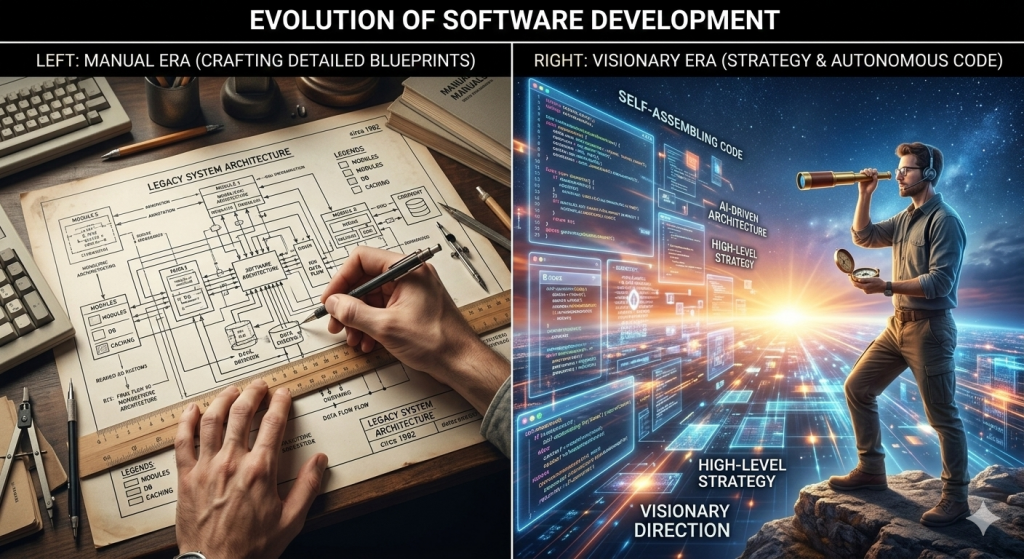
Strategic thinking, a competency often reserved almost exclusively for Staff, Principal, and Distinguished engineers in traditional models, becomes a baseline requirement for developers at all levels in the AI era. If AI levels 3 and 4 handle the granular “how” of software development—the implementation details, the database indexing, the CSS grid layouts—human engineers are left entirely with the highly abstract “what” and the “why.”
An engineer attempting to move up the competency matrix in a thoroughly AI-driven organization is evaluated almost exclusively on their ability to design overarching systems that maximize the leverage of artificial intelligence. It is the definitive shift from micro-optimization (shaving milliseconds off a database query) to macro-orchestration (designing a system where an AI agent can autonomously identify and resolve bottlenecks).
The focus shifts to identifying entirely new business models that are uniquely enabled by zero-marginal-cost software generation. Engineers must ask: “If software development is essentially free and instantaneous, what insurmountable problems can we now economically address?”
To illustrate this profound transformation comprehensively, the following table maps the standard CircleCI competency pillars against the behavioral indicators required in an advanced AI-driven development environment (Levels 3 and 4).
| Competency Pillar (CircleCI Model) | Traditional Definition (Pre-AI / Level 1) | AI-Driven Definition (Level 3 / Level 4) |
| Execution | Writing maintainable, scalable, and performant code. Deep mastery of languages, libraries, and specific syntax. | Orchestrating multi-agent AI systems. Defining rigorous constraints, guardrails, and automated validation loops for autonomous agents. |
| Delivery | Managing CI/CD pipelines, navigating legacy technical debt, ensuring on-time feature deployment and sprint completion. | Evaluating AI-generated architectures for alignment with business goals. Overseeing autonomous, self-healing deployment pipelines. |
| Problem Solving | Debugging complex logical errors, memory leaks, and system bottlenecks through analytical deduction and tracing. | Debugging AI reasoning pathways. Identifying hallucinations, refining contextual inputs, and managing the state of complex prompts. |
| Teamwork | Mentoring junior developers, participating in paired programming, and providing constructive, empathetic PR reviews. | Integrating AI outputs with human oversight. Managing silicon-based “teammates” alongside cross-functional, non-technical human stakeholders. |
| Strategic Thinking | Designing long-term technical architecture, planning for data migration, and anticipating database scaling challenges. | Identifying entirely new business models enabled by zero-marginal-cost software. Defining the precise commercial objectives the AI should build toward. |
The “Macrohard” Paradigm: Compiling the Future and Bypassing Human Syntax
As artificial intelligence pushes relentlessly toward the theoretical limits of Level 5 autonomy, a radical and highly disruptive concept begins to materialize—one famously, and perhaps playfully, alluded to by Elon Musk in the context of his xAI venture. Musk posited the creation of a technological entity termed “Macrohard,” conceptually the absolute opposite of Microsoft. While the moniker is a clever linguistic inversion, the underlying technical philosophy regarding the future of computational systems and the impending obsolescence of human programming languages is profoundly serious and rigorously logical.
The Historical Function of High-Level Languages
To understand the gravity of the Macrohard concept, one must briefly examine the history of computer science. Since the inception of assembly language, and later C, high-level programming languages (such as Python, Java, Ruby, and JavaScript) have served a single, highly specific purpose: bridging the vast cognitive gap between human understanding and machine execution.
Central processing units (CPUs) and graphic processing units (GPUs) do not inherently understand Python syntax; they understand raw binary machine code—complex sequences of 1s and 0s that manipulate microscopic logic gates. High-level languages, along with the complex scaffolding of compilers and interpreters, are merely a translation layer. They were invented exclusively to make computational logic readable, maintainable, writable, and debuggable by the human brain. They represent a compromise between what the machine needs to execute and what the human mind can successfully parse.
Bypassing the Human Intermediary
The “Macrohard” paradigm asks a structurally disruptive question: If humans are no longer the entities primarily writing or maintaining the software architecture, why are we forcing highly advanced, multi-trillion-parameter neural networks to output human-readable Python code, only to have a compiler immediately translate it back into machine code?
This process is inherently inefficient. It forces the AI to constrain its vast computational logic into the rigid, object-oriented, or functional paradigms designed specifically for human cognitive limitations. In a Level 5 AI-driven world, the artificial intelligence can bypass the human-readable intermediary layer entirely. The AI can be trained to generate executable binaries directly from a conceptual, natural language prompt or a complex system requirement.
The Profound Implications of Direct Binary Generation
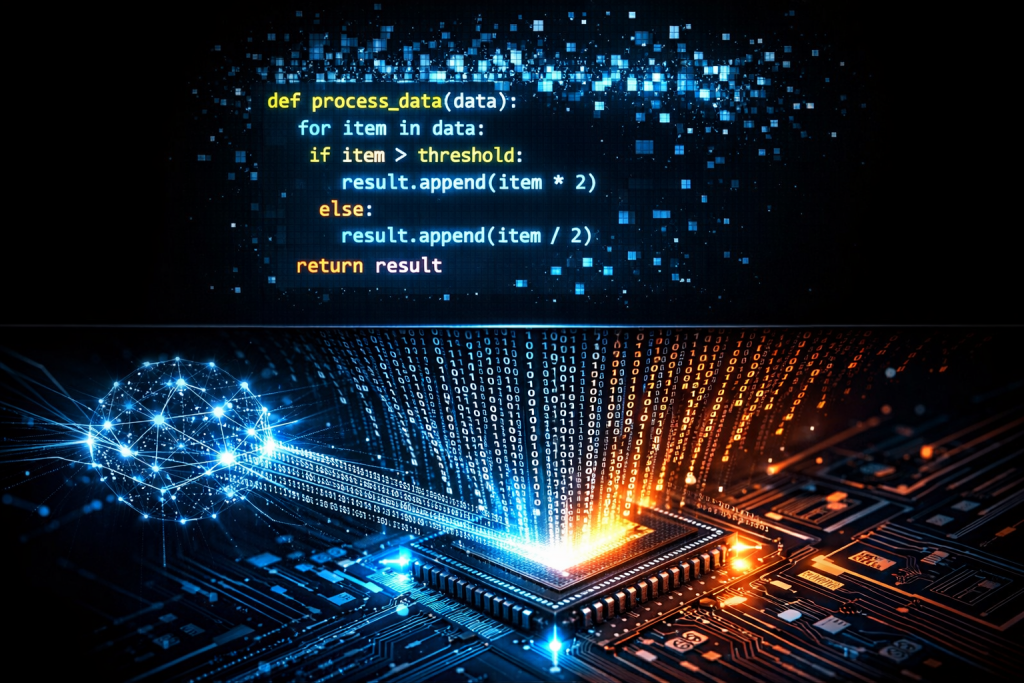
The implications of an AI system directly outputting machine code, entirely skipping the high-level syntax phase, are staggering and challenge the core tenets of software engineering.
- Unprecedented, Alien Optimization: Human-readable code is inherently inefficient because it is heavily constrained by human design patterns (such as microservice modularity, class inheritance, and readable variable naming). An AI generating direct binaries can design hyper-optimized, intricately woven algorithmic structures that are mathematically perfect for the specific hardware architecture they are executing on. This code would achieve execution speeds, memory management, and resource efficiencies far beyond any human capability, optimizing at the level of individual CPU clock cycles.
- The Black Box of Execution: If software is generated continuously as direct machine code, it cannot be traditionally debugged, reviewed, or reverse-engineered by human developers. The software becomes an absolute black box. The concept of a “pull request” ceases to exist. System verification must rely entirely on automated behavioral testing grids, formal mathematical proofs of correctness, and strict input/output validation, rather than manual code review.
- A Revolution in Security Paradigms: In a world where binaries are spawned instantly and constantly mutate to optimize performance, traditional cybersecurity models fail completely. Security must shift abruptly from analyzing static source code vulnerabilities (like searching for SQL injection flaws in a repository) to monitoring dynamic behavioral anomalies at the hardware and network levels. Security becomes an exercise in observing the outputs of a black box, rather than auditing its internal construction.
The Macrohard idea represents the ultimate, finalized decoupling of software from its human creators. The code itself becomes as alien, opaque, and mathematically complex to the human mind as the internal, multi-dimensional weights and biases of the Large Language Model that generated it. It is the absolute realization of Level 5 autonomy, where the AI is not just acting as the developer, but simultaneously as the compiler, the runtime environment, and the overarching hardware architect.
The Rise of the One-Person Unicorn and the Hyper-Leveraged Enterprise
The rapid convergence of Level 3 and Level 4 AI capabilities with the shifting, strategy-focused engineering competencies culminates in one of the most fascinating and economically disruptive socioeconomic phenomena of the modern technology era: the emergence of the hyper-leveraged solopreneur, colloquially known as the “One-Person Unicorn.”
Historically, building a technology company to a billion-dollar valuation, or even merely achieving massive revenue scale, required a vast, complex apparatus of human capital. A founder needed a Chief Technology Officer, a phalanx of backend and frontend developers, a dedicated QA testing team, product managers to write user stories, a marketing department to drive acquisition, and an enterprise sales team to close deals. This heavy operational overhead necessitated substantial venture capital funding, which inherently resulted in massive dilution of founder equity, loss of operational control, and the creation of slow, bureaucratic corporate structures.
Hyper-Leverage in Action: The Collapse of Operational Overhead
AI-driven development completely shatters this traditional organizational dependency. Today, a single individual possessing deep domain expertise, sharp market intuition, and high-level strategic thinking (the very apex of the new AI-era competency matrix) can wield the productive output and operational bandwidth of a traditional hundred-person company.
Consider the archetype brilliantly exemplified by modern operators like Vadim Strizheus. As highlighted in recent industry observations and social proof within the tech community, solopreneurs are successfully architecting, launching, and globally scaling highly complex software businesses entirely independently.
By utilizing advanced, interconnected LLMs to write the core application logic, deploying autonomous Level 3 agents for continuous integration and regression testing, leveraging generative AI for dynamic marketing copy and visual asset creation, and utilizing deeply integrated automated workflows for intelligent customer support, a single operator can generate and manage millions of dollars in recurring revenue without hiring a single W-2 employee.
The Radically Altered Tech Stack of a Solo Titan
The technological infrastructure of a one-person unicorn does not look remotely like a traditional enterprise architecture. It is not a monolith maintained by a DevOps team; it is an intricate, highly fluid web of API calls connecting specialized artificial intelligence models.
- Engineering and Architecture: Autonomous AI agents act as the full-stack development team. The solo founder inputs market feedback, and the agents constantly iterate on the product, committing code, running tests, and deploying to edge networks continuously.
- Design and Frontend: Generative UI tools and component libraries create dynamic, highly responsive front-ends in real-time, adapting to user behavior without human design intervention.
- Operations and Growth: AI-driven data pipelines autonomously analyze user behavior, predict churn vectors, and independently launch personalized, generative retention campaigns via email and in-app messaging.
The case of the solo operator unequivocally proves that in the AI era, raw technical execution has become a vastly commoditized resource. The true, irreplaceable scarcity in the market is taste, commercial intuition, and the ability to accurately identify unmet human needs. Operators like Strizheus are not succeeding because they are writing fundamentally better syntax than venture-backed competitors; they are winning because they are moving exponentially faster, iterating at a fraction of the cost, and seamlessly leveraging AI to execute their strategic vision with absolutely zero organizational friction, interpersonal politics, or communication lag.
See an 18-year-old solo founder running his entire organization with automated AI Aget teams:
Implications for the Venture Capital Ecosystem
This dynamic introduces a severe, perhaps existential, stress test to the traditional Silicon Valley venture capital model. If a single founder can conceptualize, build, deploy, globally distribute, and successfully scale a massive software platform using only a few thousand dollars in monthly AI compute credits, the fundamental rationale for raising a highly dilutive $10 million Series A round evaporates entirely.

The barrier to entry for software creation drops to near absolute zero. This will inevitably flood the market with hyper-niche, highly competent, vertically integrated software products. As a result, the accrual of massive financial value shifts away from the venture platforms providing human capital funding, and instead concentrates violently toward the foundational infrastructure platforms providing the core AI models and the vast compute power required to run them. The “startup” becomes less of a human institution and more of an algorithmic wrapper around foundational model APIs.
Broad Industry Ripples: How AI-Driven Development Restructures the Ecosystem
The deep integration of advanced artificial intelligence into the software development lifecycle does not simply accelerate the existing output of the technology industry; it fundamentally restructures its core economics, its global distribution of labor, and its underlying operational models. The software industry has historically been defined and bottlenecked by a severe lack of supply in human capital. Because engineering time has always been exceedingly expensive, fragile, and finite, businesses have been forced into relentless prioritization, building only the most critical, globally applicable features while ignoring long-tail edge cases. This reality is ending.
The Collapse of Marginal Costs and the Threat to B2B SaaS
The foundational economic shift introduced by AI-driven development is the drastic, unprecedented reduction in the marginal cost of software creation. Mathematically, the cost structure of software development is undergoing an asymptotic decline directly toward the raw cost of compute power.
Let the cost of producing complex software H be defined as a function of human labor hours and computational cost E. As the industry rapidly moves from Level 1 assistance to Level 4 autonomy, the human labor requirement approaches zero, rendering the cost equation almost entirely dependent on API token credits and server capacity:
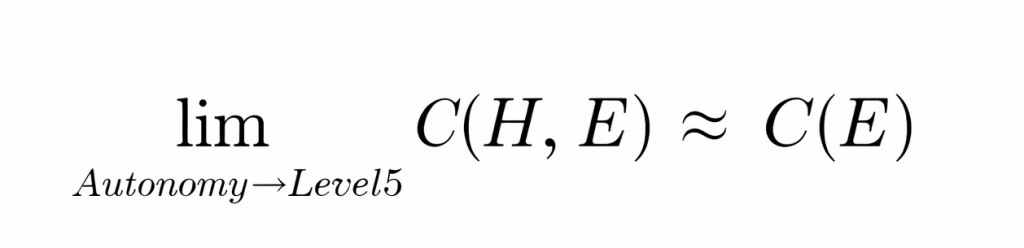
When the cost of generating custom, highly complex software drops by orders of magnitude, the definition of a “commercially viable product” expands horizontally into infinity. Large enterprise organizations will soon realize they no longer need to purchase rigid, expensive, one-size-fits-all SaaS products that require massive onboarding efforts and integration teams.
Instead, they will deploy localized Level 4 AI systems to generate bespoke, perfectly tailored internal tools that perfectly contour to their highly specific operational workflows. This phenomenon poses a severe, existential threat to massive sectors of the traditional B2B SaaS economy. If an enterprise can simply prompt its internal, secure AI to build a customized CRM, complete with secure databases and tailored UI, over a single weekend for a few hundred dollars in compute costs, the value proposition of paying exorbitant, recurring annual licensing fees to legacy software giants instantly evaporates.
The Death of the “Code Factory” and Global Arbitrage
Furthermore, the globalization of software development—specifically the massive offshore IT services, staff augmentation, and outsourcing industries—faces immediate and severe disruption. For decades, business models have been built on leveraging geographic labor arbitrage to produce high volumes of basic, rote code at a lower cost than domestic engineers.
These models are rendered instantly obsolete by the proliferation of Level 2 and Level 3 AI agents. Why would a modern enterprise outsource a legacy migration project to a team of fifty offshore developers over a six-month timeline, fraught with timezone delays and communication errors, when a localized, cloud-hosted multi-agent system can analyze the codebase, rewrite it, deliver a superior architecture, and run millions of regression tests in forty-eight hours?
The economic premium shifts violently and permanently away from the manual production of code toward the possession of deep domain expertise, the ownership of proprietary data to train these models, and the strategic foresight to know what to build in the first place.
Redefining Agile in the Age of Autonomous Agents
The ripple effects of this transformation extend deeply into project management methodologies. For the last twenty years, the software industry has been dominated by Agile methodologies, Scrum frameworks, and Kanban boards. These systems were explicitly designed to manage human limitations: they break complex, monolithic projects into small, digestible tasks (sprints) to maintain human focus, ensure continuous human communication (stand-ups), and manage human burnout.
In a Level 3 and Level 4 AI-driven environment, these frameworks become not just obsolete, but actively detrimental to velocity.
- The End of the Sprint: An AI agent does not need a two-week sprint to maintain focus; it can execute thousands of tasks simultaneously without fatigue.
- The End of Story Points: Estimating human effort (story points) becomes irrelevant when task execution is measured in milliseconds of compute rather than days of human labor.
- Continuous Flow: Project management shifts from cyclical batch processing (sprints) to a continuous, fluid flow of intent-to-execution. The human sets the intent, and the multi-agent system continuously flows code into production, self-correcting along the way.
The role of the Scrum Master or traditional Project Manager dissolves, replaced by the AI Orchestrator—an engineer whose sole job is to tune the latency, prompt constraints, and safety guardrails of the autonomous system.
Conclusion: The Strategic Imperative for the Hyper-Leveraged Future
The trajectory of the software engineering industry is unequivocally clear, and its velocity is accelerating exponentially. The progression through the five levels of AI-driven development is not a distant, speculative roadmap; it is actively unfolding in real-time, fundamentally rewriting the rules of technology creation, corporate structure, and economic leverage.
For technology leaders, engineering managers, and modern operators navigating this radically shifting terrain, the strategic imperatives are stark and unavoidable:
- Elevate the Human Element to the Abstraction Layer: As artificial intelligence rapidly commoditizes syntax, boilerplate, and execution, organizational value must be rapidly and aggressively shifted toward deep domain expertise, problem definition, and high-level strategic architecture. Engineering competency matrices, specifically modeled after the progressive CircleCI framework, must be immediately weaponized to evaluate talent not on how well they manually code, but on how efficiently they can orchestrate, manage, and direct autonomous systems.
- Embrace the Asymptotic Cost Curve: Leaders must deeply internalize the economic reality that software is actively transitioning from a highly expensive, capital-intensive asset to a nearly zero-marginal-cost utility. Business models that rely purely on the inherent difficulty and cost of writing code will rapidly collapse. Sustainable competitive moats must now be built entirely around proprietary data silos, highly engaged user communities, brand trust, and deeply unique operational workflows that AI cannot easily replicate.
- Prepare for the Post-Code Reality: Advanced concepts like direct binary generation (the “Macrohard” paradigm) dictate that the future of engineering will be highly abstract and potentially entirely opaque to human review. Corporate infrastructure, security postures, and compliance frameworks must be proactively prepared to integrate, monitor, and secure black-box AI outputs that bypass traditional, human-readable review processes.
- Harness Organizational Hyper-Leverage: The phenomenon of the one-person unicorn is not a statistical anomaly; it is a profound leading indicator of the future of the firm. Organizations must actively adopt the solopreneur mindset internally, ruthlessly eliminating bureaucratic bloat and empowering individual engineers with agentic AI tools to act as their own autonomous, hyper-leveraged business units.
Software engineering is no longer the rote, artisanal practice of writing manual instructions for a machine. It is rapidly and irreversibly becoming the highly strategic discipline of managing vast, autonomous intelligence. Those who recognize this singularity and adapt their operational frameworks to match will command unprecedented, infinite leverage in the new digital economy; those who stubbornly cling to the artisan era of manual syntax will inevitably find themselves competing against frictionless entities that conceptualize, build, and deploy at the speed of silicon.
At SummitCode, we are actively seeking visionary engineers operating at Level 3 autonomy or above to help us drive AI-First Software Delivery. If you are ready to orchestrate the future rather than just write syntax, we invite you to apply and join our team of experts.