Agentic ERP Explained: How AI-Native Operations Replace Manual Workflows
If you are a CTO or Operations Manager, you already know the operational cost of fragmented systems: teams rekey the same data into multiple tools, approvals stall in inboxes, and leaders wait for reports that are already outdated by the time they arrive. This is exactly where agentic ERP changes the operating model. Instead of treating ERP as a passive system of record, agentic ERP introduces AI agents that can move work, interpret context, and support decisions across disconnected platforms. The result is a more adaptive, AI-native way to run operations—one that reduces manual work without forcing a full rip-and-replace of your current stack.
For organizations under pressure to improve efficiency, agentic ERP is not a theoretical upgrade. It is a practical response to the realities of modern operations: distributed data, cross-functional handoffs, and a growing need for real-time insights. When implemented well, it helps teams eliminate repetitive coordination work, shorten cycle times, and make faster decisions with less friction.
Watch the article video.
Why Traditional ERP No Longer Solves the Full Problem
Traditional ERP systems remain valuable. They centralize core business functions such as finance, procurement, inventory, and order management. They create consistency, enforce processes, and help standardize reporting. But in many organizations, they do not solve the operational bottlenecks that matter most today.
The challenge is not simply whether data exists in the ERP. The challenge is whether the right action happens at the right time, across the right systems, with minimal human intervention. In practice, traditional ERP often requires people to bridge the gaps between CRM, ticketing, logistics, document management, spreadsheets, and email. That leads to manual handoffs, delayed approvals, inconsistent data, and preventable mistakes.
Common limits of traditional ERP
Manual orchestration: Staff must move tasks between systems by hand.
Fragmented visibility: Operational data is scattered across multiple applications.
Slow exception handling: Teams spend time identifying and resolving issues after they occur.
Static workflows: Rules are predefined, but they do not adapt well to changing conditions.
Reporting lag: Insights often arrive too late to support immediate decisions.
These limitations are especially costly when volumes increase or business conditions change quickly. A traditional ERP can tell you what happened. An agentic ERP environment is designed to help determine what should happen next.
What Makes Agentic ERP Different
Agentic ERP represents the next step in enterprise systems: an operational layer where AI agents can observe, decide, and act within defined boundaries. These agents do not replace core business logic. Instead, they work alongside existing ERP and adjacent systems to automate repetitive coordination work and support judgment-heavy tasks.
In practical terms, agentic ERP connects process data, business rules, and AI reasoning. It enables an organization to move from “someone has to handle this” to “the system can route, recommend, or complete this step automatically.”
The difference is important. Traditional automation usually follows fixed if-then logic. Agentic ERP can respond to context. If a purchase order is delayed, if an invoice does not match expected terms, or if an inventory threshold is breached, AI agents can investigate the issue, route it to the right owner, and initiate next actions based on policy.
Agentic ERP is not about adding AI for novelty. It is about reducing operational friction where work crosses systems, teams, and approval layers.
How AI agents operate inside an ERP environment
They monitor events and detect anomalies or exceptions.
They gather relevant context from multiple systems.
They recommend actions or route tasks to the right team.
They execute approved steps within business guardrails.
They learn from recurring patterns to improve workflow performance.
This is why agentic ERP is central to AI Transformation. It moves organizations closer to being AI-native, where AI is embedded into day-to-day operations rather than isolated in chat interfaces or side projects.

Agentic ERP in Practice: Real-World Use Cases
The strongest case for agentic ERP is operational. The value appears when AI agents take over routine coordination work that consumes time but does not require deep human expertise. Below are several high-impact use cases where businesses can begin seeing measurable value.
1. Order exception management
When an order cannot ship because inventory is missing, a pricing rule is violated, or a customer record is incomplete, staff often need to search multiple systems before they can act. An AI agent can identify the exception, pull data from ERP and CRM, notify the appropriate owner, and suggest the next step. In some cases, it can auto-route the issue based on business rules.
2. Invoice matching and accounts payable support
Invoice matching is a common source of manual effort. An agentic ERP workflow can compare purchase orders, receipts, and invoices, flag mismatches, and draft an exception summary for review. That reduces back-and-forth and helps finance teams focus on higher-value work.
3. Procurement routing
Purchase requests often stall because approvers need more context. AI agents can check budget status, supplier history, policy thresholds, and delivery urgency before routing requests. This shortens approval cycles while maintaining control.
4. Inventory alerts and replenishment support
When stock levels fall below defined thresholds, AI agents can notify planners, create draft replenishment tasks, or surface likely causes of delay. Operations teams gain faster visibility without constantly checking dashboards.
5. Internal service request handling
Requests related to IT, HR, or operations are often passed between systems and teams. Agentic ERP can classify the request, collect necessary context, and route it to the right queue, reducing response time and administrative overhead.
These use cases are valuable because they share a common pattern: the work is repetitive, cross-system, and time-sensitive. That is the sweet spot for business automation powered by AI agents.
Key Benefits of Agentic ERP
Organizations exploring agentic ERP usually focus on efficiency first, but the strategic impact is broader. By changing how work is routed and completed, agentic ERP improves the entire operational model.
Reduced manual work
Teams spend less time copying data, chasing approvals, and reconciling exceptions. This frees staff to focus on analysis, customer service, and process improvement.
Faster decisions
AI agents can surface issues earlier and provide context immediately. Instead of waiting for end-of-day reports, managers can act on real-time signals.
Better data visibility
Because agents work across systems, they help connect operational data that would otherwise remain siloed. That creates a clearer view of process health and bottlenecks.
More consistent execution
Agentic ERP applies approved rules reliably. This reduces variability in how routine work is handled and lowers the risk of missed steps.
Scalable operations
As transaction volume rises, agentic ERP helps teams absorb growth without adding the same level of headcount for coordination work.
For CTOs, this means technology can do more of the operational heavy lifting without disrupting the current stack. For Operations Managers, it means fewer manual handoffs and more predictable throughput.
Traditional ERP vs. Agentic ERP
Understanding the difference helps clarify where agentic ERP fits in your roadmap.
Traditional ERP: Centralizes data and enforces structured processes.
Agentic ERP: Adds AI agents that can coordinate and act across systems.
Traditional ERP: Relies heavily on human users for exceptions and routing.
Agentic ERP: Reduces manual intervention in repetitive workflows.
Traditional ERP: Produces reports and dashboards after data is entered.
Agentic ERP: Surfaces issues and next steps in near real time.
Traditional ERP: Works well for standardized transactions.
Agentic ERP: Works well for dynamic, cross-functional operations.
Put simply, traditional ERP tells the organization what the system knows. Agentic ERP helps the organization do something with that knowledge faster.
Implementation Considerations Before You Start
Like any meaningful transformation, agentic ERP should be implemented with discipline. The goal is not to automate everything at once. The goal is to identify workflows where AI can safely remove friction and deliver measurable value.
Start with process selection
Choose processes with clear rules, frequent exceptions, and high coordination cost. Good candidates are those where humans spend significant time moving information rather than making strategic decisions.
Map system dependencies
Document which systems are involved, what data is needed, and where approvals occur. Agentic ERP works best when integration points are understood from the beginning.
Define guardrails
AI agents should operate within clear limits. Establish what actions can be automated, what requires approval, and what must always be escalated to a human.
Prepare data quality and access
If source data is inconsistent, the agent will only accelerate the problem. Clean data, role-based access, and reliable integrations are essential.
Measure operational outcomes
Track metrics such as cycle time, exception volume, manual touchpoints, and approval delays. This gives you a baseline and shows where agentic ERP is actually improving performance.
A practical rollout often begins with one workflow, one department, and one measurable outcome. From there, the model can expand into adjacent processes as confidence grows.
Common Objections to Agentic ERP
It is normal for enterprise leaders to question whether AI agents can be trusted in core operations. The right response is not to dismiss the concern, but to address it with design and governance.
“Will AI replace our ERP system?”
No. In most cases, agentic ERP complements existing ERP investments. It enhances execution across the systems you already use rather than replacing them outright.
“How do we maintain control?”
Control comes from guardrails, approvals, logging, and clear operating rules. The right implementation should increase transparency, not reduce it.
“What if the data is messy?”
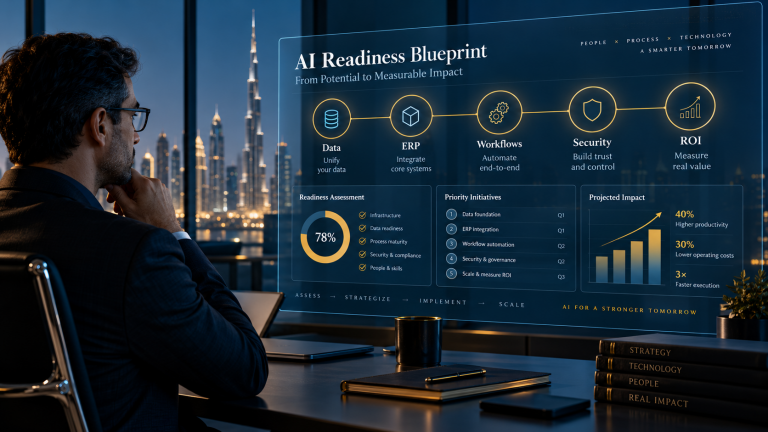
That is exactly why a readiness assessment matters. You do not need perfect data everywhere, but you do need a realistic view of where the system can safely operate first.
“Is this only for large enterprises?”
No. Mid-market organizations often see strong early value because they feel manual process pain more acutely and can move faster on implementation.
These objections are valid, but they are also manageable. The question is less about whether AI belongs in operations and more about where it can create dependable value first.
Why Agentic ERP Matters Now
The business environment has changed. Organizations are expected to operate with more speed, more accuracy, and less overhead. At the same time, most teams are still managing work across a patchwork of applications that were never designed to act together. That is why agentic ERP matters now: it closes the gap between data and action.
For companies pursuing AI Transformation, this is a foundational capability. AI CoWorkers and AI agents can take on operational work in a way that is repeatable, governable, and aligned with business goals. Over time, that shifts the organization toward an AI-native model where automation is not an add-on, but part of the operating system.
The companies that win with AI will not be the ones with the most tools. They will be the ones that connect those tools into intelligent, operational workflows.
Conclusion: A Smarter Path to AI-Native Operations
Agentic ERP is best understood as the evolution of enterprise operations. It preserves the structure and discipline of ERP while adding intelligence, adaptability, and execution across fragmented systems. For CTOs, it offers a practical way to extend automation without replacing everything at once. For Operations Managers, it reduces manual work, shortens delays, and creates better visibility into what is happening across the business.
If your organization is still relying on spreadsheets, inboxes, and manual handoffs to move core work forward, now is the right time to assess which processes are ready for AI Transformation. Start with the workflows that consume the most coordination time and produce the most exceptions. Then determine where AI agents can safely automate routing, support decisions, or complete repetitive steps.
SummitCode helps businesses design that path with AI Transformation solutions built for modern operations, including Agentic ERP and AI CoWorkers. If you want to identify the highest-impact workflows in your environment, request an AI readiness or workflow assessment and see where agentic ERP can reduce manual work, improve data visibility, and accelerate execution.