There’s a playbook circulating among your employees right now, and it’s a good one. Automate 80–90% of your job with AI. Keep delivering exactly what’s expected, so nothing looks different. Take the 10–15 hours a week you just freed up and sell them to a second employer.
Two salaries. One person. And the company that pays the first salary never finds out, because the output still arrives on time.
I run a company that builds this kind of automation for a living, so I want to be direct with you: this isn’t a rumour, it isn’t rare, and the reason it works is that most companies still don’t know what the tools can actually do. Your employees do. That gap is the whole story.
The numbers you should read twice
A Pollfish survey of 1,000 full-time US workers in April 2026 found that 60.7% had already used AI to take over tasks that used to belong to a coworker. At companies that had announced layoffs, it was 74.3%. The researchers didn’t call it a productivity story. They called it a survival story.
Ivanti’s 2025–2026 Technology at Work research, across six countries, found that 42% of office workers now use AI at work, up 61.5% year on year. A third of them hide it from their employer completely. Of those, 36% said outright that they like having a “secret advantage.” Almost half are using tools the company never approved.
Glean’s Work AI Index 2026, from 6,000 workers, puts the payoff at roughly 11 hours a week saved per employee. That’s close to a third of a work week. Only 13% of those same workers said their organisation had meaningfully improved its outcomes as a result.
Sit with that for a second. Your people are getting back eleven hours a week. You are getting back almost nothing. The gains are real; they just aren’t landing on your P&L.
Forbes has started calling this the “shadow AI economy.” People find real automation shortcuts and keep them private, because historically, sharing a shortcut earns you more work, not more pay.
Why this is your fault (in the nicest possible way)
I’m not saying this to be provocative. I’m saying it because the alternative explanation, that you have a dishonest team, is rarely true.
Look at the system you’ve built from an employee’s point of view. If they tell you they’ve automated 60% of their role, one of three things happens: they get more work at the same pay, their role gets “right-sized,” or a colleague’s does. If they say nothing, they keep the hours. Any rational person chooses silence. The Pollfish data shows exactly that: the more layoff anxiety in a company, the more quiet automation.
So the “shadow AI economy” isn’t a character problem. It’s an incentive problem. And incentive problems get solved by leadership, not by HR memos.
What most companies do about it, and why it doesn’t work
The instinct is surveillance. Activity monitoring, keystroke analytics, meeting-engagement scores, “AI usage policies” that ban unapproved tools. Workplace-analytics vendors will happily sell you all of it.
Here’s what that buys you. Your best people, the ones who figured out how to compress their week into two days, now either leave for a company that treats them like adults, or get better at hiding. The mediocre people, who never automated anything, are unaffected. You’ve spent money to lose your top performers’ goodwill and learned nothing about the work itself.
The other instinct is the licence approach: buy Copilot seats for everyone, run a lunch-and-learn, declare the company “AI-first” in a town hall. This is the corporate equivalent of buying a gym membership. It changes nothing about how the work is actually done. Prompting a chatbot to shorten an email is not automation.
What an AI-native company does instead
Automation is when the work happens without a person in the loop, and the person shows up only to review results and make decisions. That’s a different thing from “using AI,” and it’s the thing your employees are quietly doing for themselves. The fix is to do it openly, for the company, and to redesign the roles around it.
At SummitCode Labs, we’ve spent the past year doing exactly this with clients, and these are five jobs we’ve moved to 100% agentic operation:
A customer-support call centre went from four or five people handling calls and tickets to one person. That person doesn’t answer anything. They monitor, analyse patterns, and step in when something unusual comes through. Queue, responses, follow-ups, and CRM updates run on their own.
A Google and Meta SEM function now optimises itself. Campaign structure, bidding, budget shifts, creative rotation, negative keywords, audience adjustments- all continuous. The human spends about an hour a day reading the agents’ reports and approving or rejecting recommendations.
A five-person software team became one engineer orchestrating multiple coding agents to build a large enterprise application from scratch, end to end: architecture, implementation, tests, QA, staging deploys. The engineer’s job changed from writing code to running a team that writes code.
An enquiry-to-quote pipeline for a business that was dying. Enquiries arrive by email; agents extract the details, generate the RFP, collect vendor pricing, run the logistics calculations, and send the customer a quote. Margins were too thin to afford the people the process needed. Automating the process turned a closure date into a growth plan.
A fully autonomous directory business with an agent org chart: a CEO agent that owns the goals, a Data Curator, a Head of SEO, a Content & SEO Lead managing a Video/Social Producer, an Engineering Lead managing a QA Engineer, a Summarizer that writes human-readable status, and a Reflection Coach that runs evidence-based review loops on the whole team. It develops the platform, seeds and curates content, writes the blog, reads Search Console and Analytics and pushes SEO fixes, and posts to social. One person spends about an hour a day running an entire company.
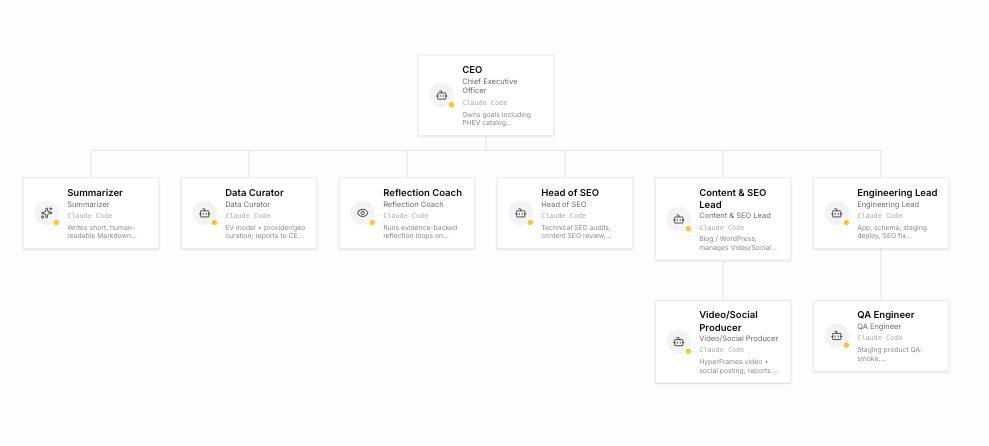
Notice the pattern. In every case, there is still a human in the chair. Their job is now supervision, judgement, and exceptions. The headcount went down, but more importantly, the person who stayed became 5–10x more valuable, and everyone involved knows exactly what the agents do. Nothing is hidden, because there’s nothing to hide.
The uncomfortable part nobody tells you
In every one of those five projects, the hard part was not the AI. The hard part was that the company had never written down how the work actually got done. The process lived in three people’s heads and a folder of half-finished SOPs. You cannot hand an agent a job you can’t describe.
This is also, incidentally, why your employees can automate their own jobs before you can: they know exactly what they do all day. You don’t. Closing that knowledge gap is the first real step, and it’s worth doing whether or not you automate anything.
A practical sequence for founders
Start by changing the incentive. Say, in writing, that anyone who automates part of their role gets to keep their job, keep their pay, and gets first pick of the more interesting work that replaces it. Then mean it. The Pollfish and Ivanti numbers tell you exactly what happens under the current deal; you need a better one.
Then map the work honestly. Pick the three most repetitive, output-measured roles in the company- reporting, support, campaign management, ops coordination- and get the people doing them to document a normal week, task by task. Most founders are shocked by how much of it is pattern work.
Automate the process, not the person. Build the agent workflow that does the Tuesday, with the employee as the supervisor and the escalation point. Their hours don’t disappear; they move to the things you’ve been meaning to get to for two years.
Finally, measure outcomes, not activity. If you’re measuring hours at the keyboard, you are measuring the one thing agents make irrelevant, and you’re rewarding the people who never automated anything.
Do that, and the 11 hours a week stop leaking to a second employer. They come back to you, in the open, from people who no longer need to keep a secret.
Where to start
If you suspect part of your team is already running the two-salary playbook, the answer isn’t to catch them. It’s to become the company they’d rather bring the hours back to.
That’s what we do at SummitCode. We map how the work actually gets done, automate the processes that can run agentically, and redesign the roles around the people who stay, so your team becomes 10x more productive with you, not around you. If you’d rather skip the hiring entirely and build something 100% agentic from day one, we do that too.
Send us a list of what your team does in a normal week, including the tasks you’re sure AI can’t handle. Those are usually the interesting ones. We’ll come back with a practical, specific approach.
Sources
- Work AI Index 2026 — Glean Work AI Institute
- AI Job Hijacking Surges to 60 Percent — Metaintro, citing a ResumeBuilder/Pollfish survey, April 2026
- AI at work: Job fears, desire for a hidden advantage drive employees to hide use — eMarketer, on Ivanti’s Technology at Work Report
- 3 Reasons Your Team Is Hiding Its Best AI Hacks From You — Forbes / Leadership IQ, July 2026