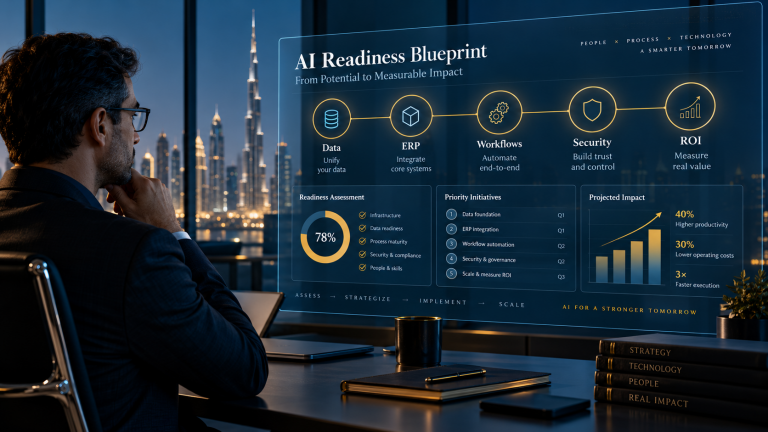
The AI Implementation Roadmap for SMEs: From First Use Case to AI-Native Operations
Most SME leaders do not need another abstract discussion about artificial intelligence. They need an AI implementation roadmap that tells them what to do first, what to avoid, how to measure progress, and when to scale. The real challenge is rarely excitement. It is sequence.
Founders are busy. CTOs are under pressure to integrate AI without breaking existing systems. Operations and finance managers are dealing with scattered spreadsheets, WhatsApp approvals, disconnected ERPs, manual reporting, and recurring questions that consume hours every week. In that environment, AI adoption can either become a serious operating advantage or another half-finished initiative.
Why SMEs Need an AI Implementation Roadmap Now
AI adoption has moved from experimentation to execution. McKinsey’s research from 2024 itself reported that regular generative AI use in organizations nearly doubled within a year, while Gartner has projected that agentic AI will become a meaningful part of enterprise applications before the end of the decade. The message for SMEs is clear: AI is no longer a side project for innovation teams. It is becoming part of how work gets done.
Yet most available advice still skips the messy middle. Many articles tell leaders to identify use cases, clean data, and train teams, but they rarely show the operating sequence: who owns what, what deliverables should exist by day 30, which decisions need leadership approval, and how to avoid pilots that never leave the demo stage.
A strong AI implementation roadmap solves four practical problems:
Unclear priorities: It separates high-ROI workflows from interesting but low-value experiments.
Operational disruption: It introduces AI in controlled workflows before expanding into core processes.
Scattered data: It identifies the minimum viable data and integrations needed for useful automation.
Team resistance: It positions AI as a workflow assistant, not a mysterious replacement program.
If you are still defining your broader AI transformation vision, SummitCode’s guide on AI transformation for SME founders is a useful strategic starting point. This article goes one layer deeper: implementation.
Phase 1: Assess Business Bottlenecks Before Choosing Tools
Timeline: Days 1 to 10
The first step in any AI implementation roadmap is not model selection. It is bottleneck discovery. SMEs often jump straight to a chatbot, reporting tool, or automation platform without clearly defining the operational drag they want to remove. That usually leads to fragmented tools and disappointed teams.
Start by mapping the recurring work that slows the business down. Look for tasks that happen daily or weekly, involve multiple people, require copying information between systems, and create delays when one person is unavailable.
High-value bottlenecks to look for
Finance: Invoice matching, expense categorization, payment follow-ups, month-end reconciliation, variance explanations, and management reporting.
Operations: Order status updates, inventory checks, supplier coordination, job scheduling, issue escalation, and daily performance summaries.
Sales administration: Lead qualification, CRM updates, proposal drafting, quotation follow-ups, and handover notes between sales and operations.
Management reporting: Weekly KPI packs, board updates, cash flow summaries, project profitability reports, and department performance reviews.
The output of this phase should be a short bottleneck register. For each workflow, capture the owner, frequency, estimated time spent, systems involved, error rate, and business impact. This does not need to be a consulting-heavy exercise. A focused workshop with department heads can uncover enough detail to move forward.
The best first AI use case is rarely the most impressive one. It is the workflow where repetitive effort, clean decision rules, and measurable business impact intersect.
Phase 2: Prioritize High-ROI AI Use Cases
Timeline: Days 10 to 20
Once bottlenecks are visible, the next step is prioritization. A practical AI implementation roadmap should force trade-offs. Not every workflow deserves to be automated immediately, even if it is annoying. The goal is to identify use cases that are valuable, feasible, and safe enough for a controlled first deployment.
Score each candidate workflow using five criteria:
Business value: Will this reduce cost, speed up revenue, improve cash visibility, or reduce operational risk?
Frequency: Does this happen often enough for automation to matter?
Data readiness: Are the required documents, records, and system fields reasonably accessible?
Workflow clarity: Can the desired outcome be described clearly?
Risk level: Can AI assist the workflow without making uncontrolled financial, legal, or customer-impacting decisions?
For many SMEs, the strongest first use cases sit in finance and operations because the pain is measurable. For example, an AI assistant that reviews supplier invoices, flags missing purchase orders, and prepares an approval summary can save hours every week while improving control. A similar assistant in operations might read order updates, identify delayed jobs, and prepare a daily exception report for managers.
If your operations team is buried in repetitive coordination work, the examples in AI coworkers for operations tasks can help you identify realistic starting points.
Decision point: automate, assist, or defer?
Not every AI opportunity should become full automation. Some workflows should begin with human-in-the-loop assistance. Use this simple decision model:
Automate: Low-risk, repetitive tasks with predictable rules and structured data.
Assist: Workflows requiring judgment, review, approval, or customer sensitivity.
Defer: Processes with unclear ownership, poor data quality, or high compliance risk.
This decision point protects the business from overreach. The aim is not to replace judgment. It is to remove manual preparation, search, checking, summarization, and routing so people can make better decisions faster.
Phase 3: Prepare the Minimum Viable Data and Integrations
Timeline: Days 15 to 45
Data preparation is where many AI projects slow down. SMEs often assume they need a perfect data warehouse before they can start. In reality, the first AI implementation roadmap should define the minimum viable data layer: the smallest reliable set of sources required to support the first workflow.
For a finance pilot, that might include your accounting system, invoice inbox, purchase order files, vendor master data, and approval matrix. For operations, it may include ERP order data, job sheets, inventory files, delivery updates, and escalation logs. For sales administration, it could include CRM records, quotation templates, email threads, and product pricing rules.
The data preparation phase should produce four deliverables:
Source inventory: A list of systems, spreadsheets, inboxes, and document repositories involved in the workflow.
Access rules: Who can view, edit, approve, and export each data type.
Data quality notes: Missing fields, duplicate records, inconsistent naming, and common exceptions.
Integration plan: APIs, secure connectors, file syncs, or controlled manual uploads needed for the pilot.
The mistake to avoid is boiling the ocean. You do not need every department connected on day one. You need enough trusted data for one AI assistant to perform one meaningful job reliably.

Phase 4: Deploy an AI Assistant in a Controlled Workflow
Timeline: Days 30 to 60
This is where the AI implementation roadmap becomes real. Instead of launching a broad AI platform across the company, deploy one AI assistant into one controlled workflow with clear inputs, outputs, and escalation rules.
At SummitCode, this is where the concept of AI CoWorkers becomes practical. An AI CoWorker is not just a chatbot answering general questions. It is a role-specific assistant designed to work inside a defined business process: reading documents, checking records, summarizing exceptions, drafting responses, updating systems, and handing off decisions to humans when needed.
Examples include:
Finance AI assistant: Reviews incoming invoices, checks vendor details, matches purchase orders, flags discrepancies, and prepares approval notes.
Operations AI assistant: Monitors job status updates, identifies overdue tasks, alerts managers to bottlenecks, and drafts daily operations summaries.
Sales admin AI assistant: Qualifies inbound leads, enriches CRM records, drafts proposal outlines, and reminds account managers about follow-ups.
Management reporting assistant: Pulls KPI data from approved sources, explains variances, and prepares weekly executive summaries.
A controlled deployment should include guardrails from the start. Define what the assistant can do independently, what requires human review, what data it can access, and which events trigger escalation. This is especially important in finance, HR, procurement, and customer-facing workflows.
For finance-specific automation ideas, review SummitCode’s breakdown of AI workflows for finance teams. The key is to start with workflows where the assistant improves speed and accuracy without bypassing approval controls.
What the pilot should deliver
A working AI assistant connected to approved data sources.
A documented workflow showing human and AI responsibilities.
A test set of real historical cases to validate output quality.
A user feedback loop for the team using the assistant daily.
A risk log covering errors, exceptions, access issues, and edge cases.
The goal of this phase is not perfection. It is confidence. Can the assistant handle most routine cases? Do users trust the output enough to rely on it? Are exceptions visible instead of hidden?
Phase 5: Measure ROI Before You Scale
Timeline: Days 60 to 75
A serious AI implementation roadmap must include ROI measurement before expansion. Without it, AI becomes a collection of demos and opinions. With it, leaders can make investment decisions based on evidence.
Measure ROI across four categories:
Time saved: Hours reduced per workflow per week.
Cycle time improved: Faster approvals, faster reporting, faster response times, or faster order handling.
Error reduction: Fewer duplicate entries, missed follow-ups, incorrect codes, or incomplete records.
Decision quality: Better visibility, earlier issue detection, and more consistent management reporting.
For example, if a finance assistant saves 12 hours per week during invoice processing and reduces approval delays by two days, the value is not just labor efficiency. It improves cash planning, vendor relationships, and month-end discipline. If an operations assistant reduces daily status-check meetings by 30 minutes and highlights exceptions earlier, managers can spend less time chasing updates and more time resolving constraints.
Decision point: scale, refine, or stop?
After 60 to 75 days, leadership should make one of three decisions:
Scale: The workflow is stable, the ROI is clear, and users trust the assistant.
Refine: The use case is valuable, but data quality, integration, prompts, or process rules need improvement.
Stop: The workflow does not justify further investment or requires organizational changes first.
This discipline protects SMEs from the common trap of expanding AI before proving value. A roadmap is not a race to deploy everywhere. It is a method for compounding results.
Phase 6: Expand Across Departments and Move Toward Agentic ERP
Timeline: Days 75 to 120 and beyond
Once one AI assistant is delivering measurable value, the next step is controlled expansion. This is where SMEs begin moving from isolated automation to Agentic ERP: a connected operating layer where AI agents coordinate work across finance, operations, sales, procurement, and management reporting.
The expansion sequence should follow business dependency, not departmental politics. If finance reporting depends on operations data, connect operations workflows before building advanced finance dashboards. If sales promises are creating delivery pressure, connect CRM, quoting, and fulfillment data. If founders are still asking multiple people for weekly updates, prioritize management reporting.
This is the point where the broader business architecture matters. SummitCode’s article on the fastest route to AI transformation for SMEs explains why businesses do not need to rebuild everything from scratch. A phased roadmap allows you to connect what already exists, replace manual handoffs, and add intelligence where it improves execution.
Expansion examples by department
Finance to operations: Link invoice approval with purchase orders, goods received notes, and project budgets.
Sales to delivery: Convert won deals into structured handover tasks, delivery timelines, and customer onboarding checklists.
Procurement to inventory: Flag low-stock risks, supplier delays, and purchase requests requiring approval.
Management reporting: Generate weekly KPI summaries from live department data instead of manually compiled spreadsheets.
As the AI implementation roadmap expands, the business starts to feel different. Leaders stop waiting for manually prepared reports. Managers stop chasing the same updates every morning. Finance gains cleaner visibility. Teams spend less time searching, copying, checking, and reminding.

Phase 7: Establish Governance Without Slowing the Business
Timeline: Starts in the pilot and continues permanently
Governance is not bureaucracy. It is what allows AI adoption to scale safely. SMEs do not need a 70-page policy before starting, but they do need clear rules around access, accountability, review, and acceptable use.
Your AI governance model should answer these questions:
Which workflows can AI assist, and which are off-limits for now?
Who approves new AI use cases?
Which systems and data sources can each assistant access?
What decisions require human approval?
How are outputs reviewed, corrected, and improved?
How are errors, bias, privacy issues, or security concerns escalated?
For SMEs in regulated or fast-modernizing markets, governance also helps prepare for external expectations. Businesses in Dubai and the wider UAE, for example, are seeing more momentum around agentic AI readiness and digital operating models. If this context matters to your business, SummitCode’s explainer on getting ready for Dubai’s Agentic AI direction is worth reading.
A Simple 30-60-90 Day AI Implementation Roadmap
If you need a practical starting sequence, use this 30-60-90 day AI implementation roadmap as a working blueprint.
Days 1 to 30: Identify and design the first use case
Run bottleneck workshops with finance, operations, sales admin, and leadership.
Create a ranked use case list using value, feasibility, risk, and data readiness.
Select one controlled workflow for the first AI assistant.
Document current process steps, exceptions, systems, and approval rules.
Confirm baseline metrics such as hours spent, cycle time, error rate, and reporting delays.
Days 31 to 60: Build and deploy the pilot
Connect minimum viable data sources and required integrations.
Configure the AI assistant for a specific role and workflow.
Test against historical cases and refine outputs.
Launch with a small group of real users.
Capture feedback, exceptions, and accuracy issues daily.
Days 61 to 90: Measure, improve, and prepare to scale
Compare actual results against baseline metrics.
Calculate time savings, cycle-time improvement, and quality gains.
Refine data access, workflow rules, and escalation paths.
Decide whether to scale, refine, or stop.
Choose the next department or connected workflow for expansion.
This 30-60-90 day AI implementation roadmap is intentionally focused. It prevents the project from becoming too broad too early. SMEs win by proving value quickly, building trust with users, and expanding into adjacent workflows with evidence.
How to Handle the Four Common AI Implementation Fears
Fear 1: AI will disrupt the business
Disruption usually happens when AI is introduced without process boundaries. Start with assisted workflows, human approvals, and limited data access. A controlled AI implementation roadmap reduces disruption because it changes one workflow at a time.
Fear 2: The team will resist it
Resistance is often a communication problem. If employees think AI is being used to judge or replace them, adoption suffers. Position AI assistants as relief from repetitive work: preparing reports, checking records, drafting summaries, and surfacing exceptions. Involve users early and let their feedback shape the pilot.
Fear 3: ROI is unclear
ROI becomes unclear when use cases are vague. Before building anything, define the baseline. How many hours are spent? How many delays occur? How often are reports late or wrong? A strong AI implementation roadmap makes ROI visible because every pilot begins with measurable pain.
Fear 4: We lack technical expertise
SMEs do not need to become AI labs. They need the right implementation partner, clear business ownership, and reliable technology services. The internal team should own the workflow and business rules. The technology partner should handle AI architecture, integrations, security, assistant design, testing, and deployment.
What a Good AI Implementation Partner Should Deliver
Choosing the right partner is a major decision point. A vendor selling generic tools may not understand how your finance approvals, operations handoffs, reporting packs, and ERP data actually work. A strong partner should help you move from business bottleneck to deployed AI capability.
Look for a partner that can deliver:
A practical AI implementation roadmap tied to business outcomes.
Use case prioritization based on ROI, feasibility, and risk.
Secure data and system integration planning.
Role-specific AI CoWorkers for finance, operations, sales admin, and reporting.
Agentic ERP architecture that connects workflows over time.
Governance, testing, and human-in-the-loop controls.
Post-launch measurement and improvement support.
The difference between AI experimentation and AI transformation is operating discipline. The companies that benefit most are not necessarily the ones with the biggest budgets. They are the ones that choose the right first workflow, deploy safely, measure honestly, and scale with purpose.
Build Your First AI Implementation Plan With SummitCode
If your business is ready to adopt AI but you are not sure where to start, SummitCode can help turn the idea into a structured implementation plan. We work with SMEs to assess bottlenecks, select high-ROI use cases, prepare data and integrations, deploy AI CoWorkers, and build toward Agentic ERP operations.
Your first step does not need to be a company-wide transformation. It can be one carefully chosen workflow that saves time, improves visibility, and proves the model for the rest of the business.
SummitCode designs AI implementation roadmaps for SMEs that want practical results, not vague AI ambition. If you are ready to move from scattered systems and manual work to AI-native operations, start by designing your first 30-60-90 day AI implementation plan with SummitCode.