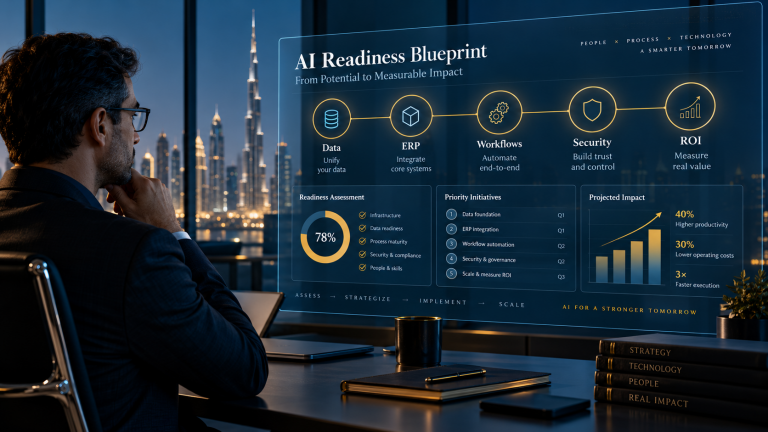
Why AI Transformation Is Becoming a Competitive Advantage for SME Founders
Most SME founders are not short on ambition. They are short on time, clean visibility, and operational capacity. One hour is spent reviewing finance numbers, the next on customer issues, then supplier follow-ups, team questions, hiring decisions, and overdue process fixes. Meanwhile, the business data that should guide decisions is spread across spreadsheets, accounting software, inboxes, CRMs, messaging apps, and individual employees’ heads.
This is exactly why AI transformation is moving from a future-facing technology topic to a practical founder priority. For small and mid-sized businesses, AI transformation is not about chasing every new tool. It is about building an operating model where lean teams can move faster, reduce manual work, and make better decisions without adding unnecessary complexity or headcount.
Larger companies have historically used scale as an advantage. They could afford more analysts, more coordinators, more managers, and more software. Today, AI-native operations give SMEs a different path: do more with less, respond faster than bigger competitors, and turn scattered work into connected, intelligent workflows.
What AI Transformation Really Means for an SME
In practical business terms, AI transformation means redesigning how work gets done so that AI, automation, connected data, and intelligent systems become part of daily operations. It is not limited to chatbots or isolated productivity tools. It affects how tasks are triggered, how information moves, how reports are created, how decisions are supported, and how teams coordinate.
For an SME founder, AI transformation may include:
Automating repetitive work such as invoice processing, data entry, reporting, lead qualification, follow-up reminders, and ticket routing.
Connecting scattered data across finance, sales, operations, support, inventory, and project management systems.
Deploying AI CoWorkers that assist teams with research, customer responses, document generation, workflow execution, and internal knowledge retrieval.
Modernizing ERP into an Agentic ERP environment where business processes are not just recorded, but actively coordinated and optimized.
Improving decisions with real-time visibility into margins, cash flow, delivery performance, customer trends, and operational bottlenecks.
The difference between basic software adoption and AI transformation is depth. Buying another SaaS tool may solve one visible issue. AI transformation looks at the whole operating system of the business and asks: where is time being lost, where is knowledge trapped, and where can intelligent automation create measurable leverage?
Why the Timing Matters Now
AI adoption has accelerated because the technology has become more accessible, but the more important shift is operational. Businesses now expect faster responses, cleaner reporting, personalized service, and tighter margins. Customers do not lower expectations just because a company is smaller. Suppliers, lenders, and partners also expect accurate data and reliable execution.
At the same time, many SMEs are facing familiar constraints: hiring is expensive, experienced staff are difficult to retain, and manual coordination does not scale. A founder can add more people, but if the underlying processes remain fragmented, headcount often adds more communication overhead instead of solving the root problem.
Recent market trends show that AI is no longer being evaluated only by innovation teams. Operations, finance, HR, sales, and customer support leaders are all looking for practical AI use cases that reduce workload and improve responsiveness. The winners are not necessarily the companies with the most tools. They are the companies that integrate AI into the work that actually affects revenue, cost, customer experience, and decision speed.
This is where SMEs can gain ground. A smaller business can often change faster than a large enterprise. There are fewer approval layers, fewer legacy politics, and shorter feedback loops. With the right AI transformation strategy, a founder-led company can move from idea to implementation quickly and build an operational advantage before larger competitors finish internal alignment.
AI Transformation Helps Lean Teams Operate With More Speed
Speed is one of the clearest benefits of AI transformation. In many SMEs, delays rarely come from lack of effort. They come from handoffs. A customer request waits for a manager to check inventory. A finance report waits for exports from three systems. A sales proposal waits for updated pricing. A founder waits for someone to compile the latest numbers before making a decision.
AI-native workflows reduce those waiting periods by making information easier to retrieve, summarize, and act on. For example, an AI CoWorker can gather customer history, open invoices, recent support tickets, and contract details before a team member responds. An Agentic ERP can trigger follow-up tasks when stock levels, purchase orders, or delivery timelines change. A finance workflow can classify expenses, flag anomalies, and prepare weekly summaries without someone manually rebuilding the same spreadsheet.
Speed does not mean removing human judgment. It means reserving human judgment for the decisions that truly need it. When AI handles the repetitive preparation work, teams spend more time solving problems and less time searching for context.
Start With Bottlenecks, Not Technology
A common mistake is to begin AI transformation by asking, Which AI tool should we buy? Founders get better results by asking a different question: Where is the business slowing down because people are doing work that systems should support?
Use cases should be prioritized based on business impact, process frequency, data availability, and implementation complexity. A simple scoring method can help:
Identify recurring pain points. Look for tasks repeated daily or weekly across finance, operations, sales, support, or management.
Estimate the time cost. Calculate how many hours the team spends collecting data, copying information, chasing updates, or preparing reports.
Measure the risk of errors. Manual work often leads to missed follow-ups, incorrect numbers, duplicated records, or inconsistent customer communication.
Assess business value. Prioritize workflows connected to cash flow, customer satisfaction, delivery performance, sales conversion, or founder decision-making.
Confirm data readiness. AI performs better when systems are connected and data definitions are clear.
For many SMEs, the best first AI transformation project is not the most glamorous one. It is the bottleneck that everyone complains about, happens constantly, and has a clear financial or operational impact.
Practical Use Cases Across the Business
Operations: From Reactive Coordination to Proactive Execution
Operations managers often carry the burden of fragmented systems. Orders live in one platform, stock in another, delivery updates in messages, and exceptions in someone’s notebook. AI transformation helps by connecting events and triggering the right action automatically.
For example, when a supplier delay appears, an intelligent workflow can notify the operations lead, identify affected customer orders, suggest revised delivery dates, and prepare customer communication. Instead of discovering the issue after a missed deadline, the team sees the risk earlier and acts with better context.
Finance: Cleaner Visibility and Faster Reporting
Finance managers in SMEs often spend too much time reconciling data rather than interpreting it. Monthly reporting can become a manual assembly process involving bank feeds, accounting exports, invoices, payroll files, and operational spreadsheets.
AI transformation can automate categorization, flag unusual transactions, summarize cash flow movements, and produce management-ready commentary. More importantly, it can connect finance data to operational activity. A founder can see not only what margins are, but why they are changing: delayed projects, overtime, supplier cost increases, discounts, or slow collections.
Customer Support: Consistent Service Without Overloading the Team
As SMEs grow, customer support volume usually rises before the team is ready. AI CoWorkers can assist by drafting responses, retrieving policy information, summarizing ticket history, routing issues, and identifying recurring complaints. This improves consistency while keeping humans involved in complex or sensitive cases.
The value is not only faster replies. It is better organizational learning. If customers keep asking the same question, AI can surface the pattern and help the business update onboarding, documentation, product pages, or internal processes.
Internal Coordination: Less Chasing, More Accountability
Many founder-led businesses run on informal communication. That works at a small size, but it becomes fragile as teams, customers, and projects increase. AI transformation improves internal coordination by converting conversations into tasks, summarizing meetings, tracking decisions, and reminding owners before deadlines are missed.
This creates a more consistent management rhythm. The founder no longer has to be the memory of the company. The operating system captures commitments, connects them to workflows, and keeps the team aligned.

Reducing Dependency on Manual Work
Manual work is not always obvious. It hides inside small habits: copying data between systems, retyping customer information, checking whether a payment arrived, reminding a colleague to update a task, searching old emails for contract terms, or building the same report every Friday.
Individually, these tasks seem manageable. Collectively, they drain capacity and create risk. They also make the business dependent on specific people who know how things are done. When one employee is unavailable, the process slows down or breaks.
AI transformation reduces that dependency by documenting workflows, connecting systems, and automating routine execution. Instead of relying on memory, the business relies on repeatable processes. Instead of waiting for manual updates, systems capture and distribute information. Instead of asking people to monitor every exception, AI can surface what needs attention.
This does not make teams less valuable. It makes their work more valuable. Employees can focus on customers, problem-solving, improvement, and relationship-building instead of administrative repetition.
Improving Decision-Making With Connected Data
Founders often make decisions with incomplete or outdated information because waiting for perfect data is not realistic. The problem is that fragmented data creates blind spots. Sales may look strong while cash collection is weak. Revenue may grow while margin declines. Customer satisfaction may appear stable while support tickets reveal frustration in one product line.
AI transformation improves decision-making by bringing relevant data together and presenting it in a usable form. This can include real-time dashboards, narrative summaries, anomaly detection, predictive insights, and scenario modeling.
For example, a founder might ask:
Which customers are most likely to churn based on recent support activity and payment delays?
Which projects are profitable after factoring in delivery time, rework, and supplier costs?
Where are we losing the most time between sales approval and fulfillment?
What cash flow risks are likely in the next 30 to 60 days?
Which internal tasks are repeatedly overdue and causing downstream delays?
These are not abstract analytics questions. They are management questions. AI transformation gives founders a practical way to answer them faster and with more confidence.
The Hidden Cost of Disconnected Systems
Many SMEs reach a point where every department has selected its own tools. Finance uses one system, sales uses another, operations uses spreadsheets, support uses a helpdesk, and leadership receives summaries through email. Each tool may be useful on its own, but the business suffers when they do not work together.
Disconnected systems create several costs:
Duplicate work because the same data is entered multiple times.
Inconsistent reporting because teams use different definitions for customers, revenue, status, or completion.
Slow handoffs because information must be requested manually.
Poor visibility because leadership cannot see the full picture without consolidation.
Higher software waste because tools overlap without forming a coherent operating model.
Agentic ERP is one response to this challenge. Traditional ERP systems have often been seen as heavy systems of record. Agentic ERP moves further by helping coordinate actions, automate workflows, and support decisions across departments. For SMEs, that means the ERP layer becomes less of a static database and more of an intelligent operational backbone.
The goal is not to replace every system overnight. It is to create a connected architecture where information flows reliably and AI can act on the right context.
How Founders Can Approach AI Transformation Without Overcomplicating It
AI transformation should be strategic, but it should not become an endless planning exercise. Founders need a practical roadmap that balances ambition with execution.
1. Map the Current Operating Friction
Start with the daily reality of the business. Where do teams wait for information? Which reports take too long? Which tasks depend on one person’s knowledge? Which customer issues repeat? Which decisions are delayed because data is scattered?
2. Select Two or Three High-Value Use Cases
Choose use cases that are visible, measurable, and achievable. Strong early candidates include finance reporting, customer support triage, sales follow-up automation, operations exception handling, document processing, and internal knowledge search.
3. Clean and Connect the Data Needed
AI transformation depends on usable data. This does not require perfection, but it does require clarity. Define key records, eliminate obvious duplication, connect core systems, and establish ownership for important data fields.
4. Design Human-in-the-Loop Workflows
The best SME implementations combine automation with accountability. Let AI draft, summarize, classify, recommend, or trigger. Keep humans responsible for approvals, exceptions, judgment calls, and relationship-sensitive decisions.
5. Measure Outcomes, Not Activity
Measure the impact in business terms: hours saved, faster response times, fewer errors, shorter reporting cycles, improved cash visibility, higher conversion rates, or reduced overdue tasks. If a project does not improve a meaningful metric, revisit the workflow.
6. Build Toward an AI-Native Operating Model
Once early use cases prove value, expand thoughtfully. The long-term objective is an AI-native company where intelligent systems support the daily rhythm of operations, not a patchwork of disconnected experiments.

Why AI Transformation Is a Founder-Level Decision
AI transformation cannot be delegated only as an IT project. Technology matters, but the deeper question is operational: how should the business work as it grows?
Founders understand the trade-offs better than anyone. They know which customers matter most, which processes are fragile, which reports they distrust, which employees are overloaded, and which delays repeatedly cost money. That perspective is essential for choosing the right use cases and setting the right priorities.
At the same time, founders should not have to become AI architects. Successful AI transformation requires strategy, process design, data integration, automation, user adoption, and reliable implementation. This is where the right technology partner becomes valuable.
How SummitCode Helps SMEs Become AI-Native
SummitCode helps small and mid-sized businesses move from scattered systems and manual work toward AI-native operations. The focus is not simply adding AI on top of old processes. It is building practical, connected capabilities that improve how the business runs.
Through AI Transformation services, Agentic ERP, AI CoWorkers, business automation, and expert technology implementation, SummitCode works with founders and leadership teams to identify bottlenecks, design the right workflows, connect data, and deploy systems that fit the business reality.
That may mean automating finance reporting, creating AI-assisted customer support workflows, building internal knowledge assistants, connecting operational data, or modernizing ERP into a more intelligent coordination layer. The common thread is business value: less manual workload, better visibility, faster execution, and a stronger foundation for growth.
The competitive advantage is not AI by itself. It is an operating model where people, data, workflows, and intelligent systems work together with less friction.
Final Thought: Start Where AI Removes the Most Friction
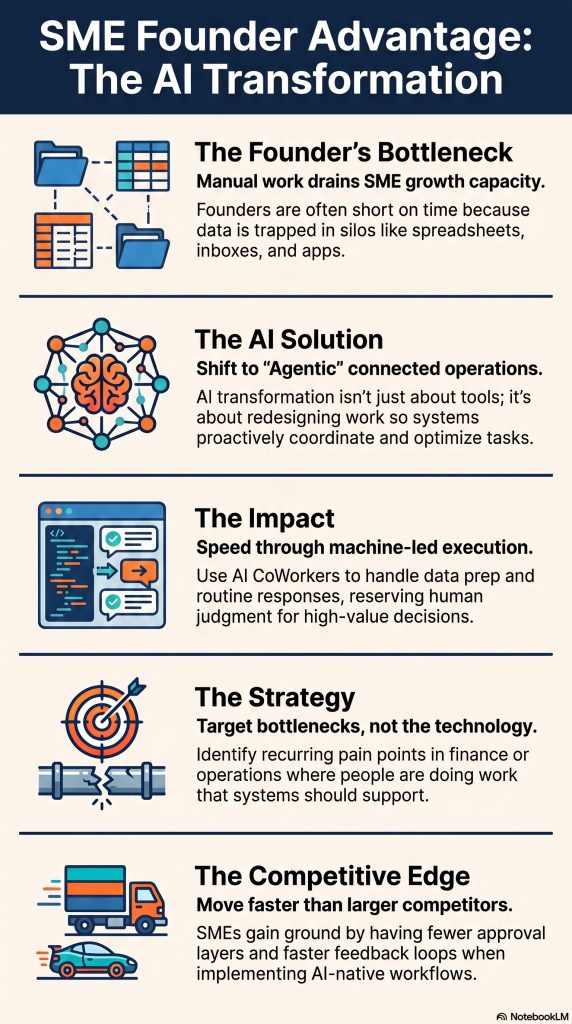
For SME founders, the question is no longer whether AI transformation will affect the business. It already is affecting customer expectations, competitor speed, employee productivity, and the economics of growth. The more useful question is where to begin.
Start with the bottleneck that costs the most time, creates the most errors, or slows the most important decisions. Look for the manual work that keeps returning no matter how busy the team gets. Identify the data that leadership needs but cannot access quickly. Those are the places where AI transformation can create early, measurable value.
If your business is ready to reduce manual workload, connect scattered data, and build a more scalable operating model, SummitCode can help you evaluate where AI can remove bottlenecks first. With the right strategy, technology, and implementation support, your company can become AI-native without losing the practical discipline that made it successful in the first place.