If you run a small or mid-sized business in Dubai, you’ve probably heard the phrase “Agentic AI mandate” a few times in the last two months, maybe on LinkedIn. Maybe in a WhatsApp group chat that’s ironically the exact kind of workflow this mandate wants to replace.
Here’s the short version: it’s real, it has a deadline, and it isn’t optional in spirit even if it isn’t a fine-issuing law today. Here’s the longer version — what it actually says, why it’s different from every other government AI strategy you’ve seen, and what an SME can do about it starting this quarter.
Watch the explainer below.
The Mandate, in Plain English
On 4 May 2026, Dubai’s Crown Prince Sheikh Hamdan bin Mohammed bin Rashid Al Maktoum launched a two-year initiative to move the emirate’s entire private sector toward Agentic AI — systems described as “self-executing and self-leading,” capable of taking action rather than just answering prompts.
The delivery mechanism runs through the Dubai Chamber of Commerce, with four concrete pieces:
- Specialised training tracks for every business council affiliated with the Chamber
- Government-funded incubators for agentic AI companies
- New economic opportunities for young people entering the field
- Dedicated investment funds to back the transition
It didn’t arrive out of nowhere. Eleven days earlier, on 23 April 2026, the UAE Cabinet had already committed to delivering 50% of federal government services through autonomous AI agents by 2028. Dubai’s private-sector mandate is the commercial mirror of that federal commitment — and in June 2026, the plan got sharper numbers attached: an executive plan aiming to empower roughly 295,000 companies, deliver 100 specialised AI assistants, and seed 50 new agentic AI companies over the two-year window.
That’s not a pilot programme. That’s a city deciding, out loud, on a public deadline, that “using AI” is no longer the finish line — running on it is.
Why “Agentic” Is the Word That Matters
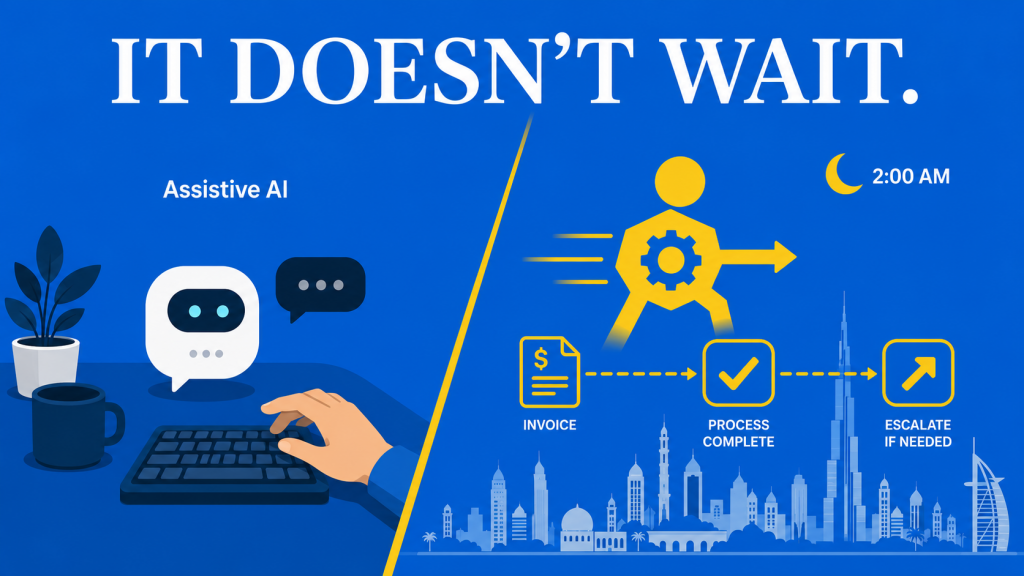
Most companies have already adopted some AI — a chatbot here, a copilot there, something that drafts an email or summarises a document. That’s assistive AI. It waits for you.
Agentic AI doesn’t wait. It’s built to check information, make a decision, trigger the next step, and only escalate when something falls outside its rules. The difference isn’t a technical footnote — it’s the difference between hiring a very fast intern and hiring an autonomous team member who clocks in at 2 am to chase an overdue invoice without needing to be asked twice.
That’s also exactly where things get uncomfortable for a lot of SMEs.
The Gap Nobody’s Advertising
Here’s a number worth sitting with: a recent Deloitte survey found that 74% of companies plan to deploy agentic AI within two years — but only 21% report having a mature governance model for autonomous agents. That’s a massive gap between intention and readiness, and it shows up everywhere once you start looking.
Dubai’s government has gone almost entirely paperless. Licensing, VAT filing, visa renewals — all a few clicks. Walk into the average SME’s back office, though, and you’ll often still find:
- A WhatsApp group functioning as the real approval workflow
- An Excel sheet the team trusts more than the actual accounting system
- Invoices manually retyped between three different tools
- One person who quietly is the ERP — let’s call him Ahmed
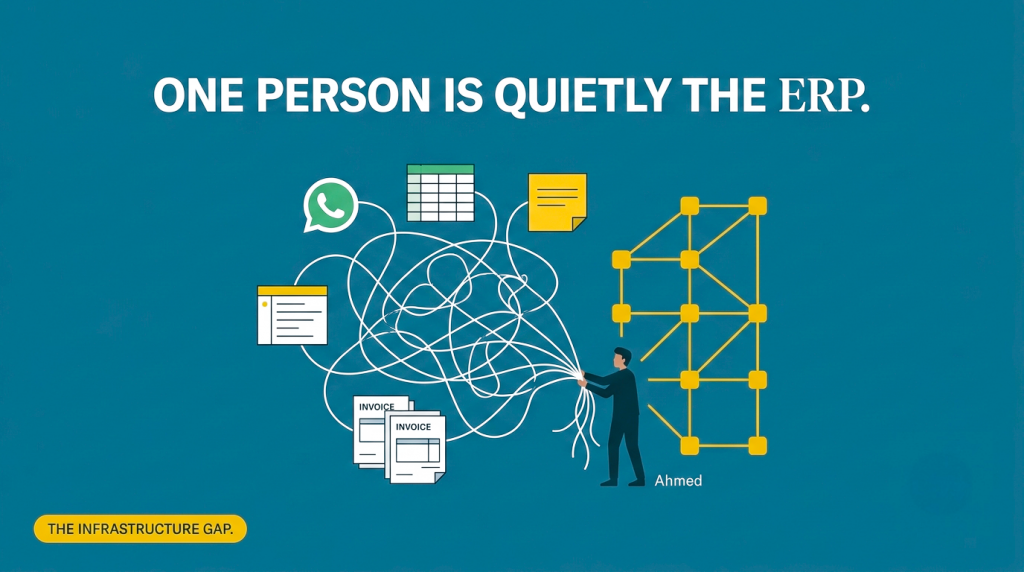
None of this makes an SME a bad business. It makes it a business that grew faster than its systems did — which describes most of Dubai’s private sector, and honestly most SMEs anywhere. But it does mean the mandate’s two-year clock is ticking against an infrastructure gap, not just a knowledge gap. Training tracks teach people what agentic AI can do. They don’t rebuild a company’s data structure, approval rules, or system integrations — the actual scaffolding an agent needs to operate safely.
You can’t hand an autonomous agent a process that only exists in someone’s head. It won’t know when to stop, who to escalate to, or what “done” looks like. And if the data behind it is messy, the agent won’t quietly ignore that — it will act on it, quickly, and at scale.
So, Where Does an SME Actually Start?
Not with buying an AI tool. With three questions, in this order:
1. Which process is painful, repetitive, and safe enough to hand over? Dispatch follow-ups for a logistics company. Insurance approval tracking for a clinic. Stock replenishment for a retailer. Lead qualification for a real estate team. Invoice matching for finance. CV screening for HR. Every industry has at least one candidate process that’s measurable, repetitive, and low-risk enough to be a sensible first agent.
2. Is the underlying system actually structured — or just familiar? If your “system” is a shared inbox and a spreadsheet, an AI agent has nothing solid to stand on. This is usually the real project: consolidating finance, HR, inventory, and CRM data into one connected backbone before anything gets automated on top of it.
3. Where do humans need to stay in the loop, and where can they step back? Agentic AI doesn’t mean zero oversight — it means deliberate oversight. Approval limits, exception rules, and escalation paths need to be decided on purpose, not discovered the first time an agent does something nobody expected.
Get those three answers right, and the mandate’s two-year window stops looking like a deadline and starts looking like a head start.
How SummitCode Fits Into This
This is the exact gap SummitCode was built to close, from both ends:
- Agentic ERP gives SMEs the structured backbone agentic AI actually needs — finance, HR, inventory, and CRM running on a single connected ERPNext-powered system instead of five disconnected tools held together by habit.
- CoWork, our AI CoWorkers platform, is where the “agentic” part actually shows up day to day — agents that chase follow-ups, flag exceptions, update records, and handle the repetitive work Ahmed has been quietly carrying for years, minus the annual leave requests.
- SummitCode Academy and Experts cover the training and implementation side — the part of the mandate that’s easy to announce and genuinely hard to execute without experienced hands.
We’re not selling “AI adoption” as a checkbox. We’re helping businesses build the operating model the mandate assumes they already have.
The Real Competitive Advantage
Dubai has built the infrastructure, the funding, and the urgency. What it can’t hand every SME is a clean process to plug an agent into — that part is homework, and it’s due before the two years are up.
The businesses that win this transition won’t be the ones with the biggest AI budget. They’ll be the ones whose workflows were clean enough for an agent to actually run — reliably, without supervision, without surprises.
Dubai has created the deadline. The rest is implementation discipline.