Looking for WhatsApp construction software? Here is the honest answer: WhatsApp was never built to run a contracting business. It cannot hold a job cost, approve an LPO, track retention, or tell you which project is quietly losing margin. The alternative UAE contractors are moving to is not a better chat app — it is an Agentic ERP: one operating system for projects, procurement, finance, and HR, with AI agents that do the chasing for you.
This guide is for UAE construction and manufacturing companies still running on WhatsApp groups, voice notes, and Excel. It covers why chat breaks down as you grow, what to use instead, and how SummitCode's Agentic ERP for construction gets a company off chat-and-hope in 90 days. First, what that chaos looks like on a Monday morning.
How UAE Construction and Manufacturing Companies Are Finally Escaping the Spreadsheet-and-Chat-Screenshot Era — In 90 Days
Monday, 7:45 AM. The Usual Chaos.
Khalid is the operations director of a mid-sized contracting company in Dubai. He has 14 active projects, three subcontractors who haven’t submitted LPOs yet, one foreman on WhatsApp asking about a delivery that was apparently approved in a voice note three weeks ago, and a CFO waiting for last month’s margin report that someone is still “building in Excel.”
By 9 AM, he’s already put out four fires that started before he arrived.
By 11 AM, the fire he should have seen coming — a subcontractor overrun that’s been quietly eating into margin for six weeks — finally surfaces. In a WhatsApp forward. From the site manager. Who heard it from the foreman.
Sound familiar? You’re in good company. And also in serious trouble.
The UAE construction and manufacturing sector moves fast. Projects get awarded on trust, executed on pressure, and reported on… well, whenever someone has time to update the Excel file. Which is apparently never, because that person is also the one doing the material reconciliation, chasing three suppliers, and answering the same question about VAT invoicing for the eighteenth time this month.
This isn’t a people problem. Your team is working hard. This is a systems problem — and specifically, the absence of one.
The Duct Tape Architecture of a Typical UAE Contractor
Let’s be honest about how most construction and manufacturing SMEs in the region actually run their operations:
⚠️ Finance: One accountant, two Excel files, a Tally license nobody fully understands, and a prayer before month-end close.
⚠️ Procurement: Purchase requests via WhatsApp. LPO approvals via WhatsApp. Delivery confirmations via… you guessed it.
⚠️ HR & Payroll: A spreadsheet per nationality (because different rules), manual WPS uploads, and leave tracking that depends on whether the HR manager remembered to check the shared Google Sheet.
⚠️ Inventory & Materials: Either dangerously under-ordered or sitting in a warehouse nobody checked. Often both, on different sites, simultaneously.
⚠️ Project Reporting: A PowerPoint your project manager updates before every client meeting, from numbers he got from a foreman who estimated from memory.
⚠️ CRM / Business Development: The MD’s brain, a business card pile, and a Notion page that was last updated in February.
The result? Decisions get made on gut feel, outdated reports, or whoever shouts loudest in the weekly catch-up. Your margins are invisible until it’s too late to do anything about them. And the company is entirely dependent on three or four people who carry all the institutional knowledge in their heads — which is fine, until one of them resigns or goes on leave
Real Talk: 💡 A contractor generating AED 50M in annual revenue in the UAE is, statistically, leaving 8–12% of that on the table in cost leakage, process waste, and delayed decisions. That’s AED 4–6M a year. Not because the business is bad. Because the operations have no nervous system.
What ‘Fixing It’ Usually Looks Like (And Why It Fails)
Most contractors eventually reach a breaking point and decide to ‘get proper software.’ So they bring in an ERP vendor. Six months later, the system is live — technically. Nobody’s really using it. The procurement team still sends WhatsApp because ‘it’s faster.’ Finance still closes manually. And the business has spent a six-figure sum on a glorified database that nobody wants to touch.
This is not a story about bad software. This is a story about implementation without transformation.
The problem isn’t that ERP doesn’t work for construction or manufacturing companies. A unified operating system is genuinely built for this — inventory, procurement, project costing, multi-site operations, HR, finance. The problem is that software alone doesn’t change behavior. People revert to old habits unless the system is set up to meet them where they are, guide them through new workflows, and make the right path the easiest path.
So — What on Earth Is Agentic ERP?
Think of it this way. Traditional ERP is a very smart filing cabinet. You put things in, you take things out. It organizes. It stores. It reports. But it sits there, waiting for you to act.
Agentic ERP is different. It’s ERP with a brain — and hands.
It combines a unified data backbone — one operating system for projects, procurement, finance, and HR — with AI agents that read context, take action, flag risks, and move work forward — without waiting for someone to log in and click a button.
Here’s what that looks like in a real construction company:
• An invoice arrives from a subcontractor → the AI reads it, matches it to the PO, flags any discrepancy, creates a draft payable entry, routes it for approval, and notifies the project manager — all before the accountant even opens her laptop.
• A delivery happens on site → the site supervisor marks it received on a simple mobile form → inventory updates, the corresponding PO closes, and the supplier is queued for payment — without a single phone call.
• A project starts running over budget → the system detects the trend three weeks before month-end, surfaces it in the MD’s dashboard with context, and suggests where the overrun is coming from — before it becomes a crisis.
• A sales lead responds to a proposal → the CRM records the interaction, the AI drafts a follow-up, updates the pipeline, and sets the next action — without the BD manager needing to remember anything.
Contractor Translation: 🏗️ Instead of your operations manager chasing seven different people for seven different updates, the system already knows — and it already did something about it. Your operations manager can now focus on actual operations, not information archaeology.
The Three Stages — And What Each One Feels Like
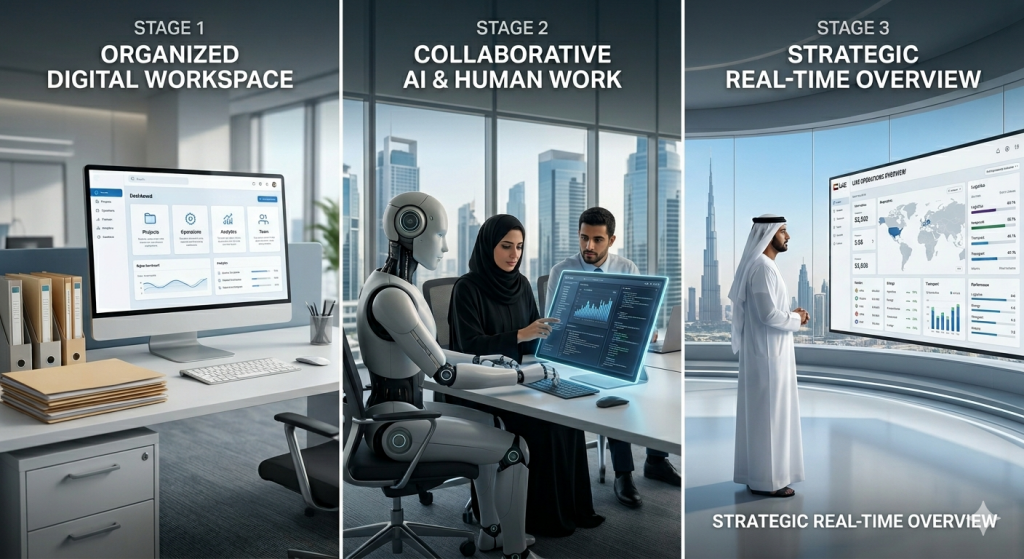
Here’s something refreshingly honest: you don’t flip a switch and become an AI-native
company overnight. There are three distinct stages, and each one delivers value on its
own. You don’t have to sprint to Stage 3 immediately (though once you see Stage 2,
you probably will want to).
Stage 1: ERP Foundation — “Finally, One Version of the Truth”
This is the backbone. The Agentic ERP foundation, a unified operating system rather than a patchwork of tools, gets set up and configured for your specific business — construction project structures, cost centers by site, subcontractor management, procurement workflows, HR and WPS-ready payroll, multi-warehouse inventory, and live finance.
Your data migrates from the spreadsheets, the Google Sheets, the Tally, the old system nobody likes. Your team gets trained. Dashboards go live.
What it feels like:
Week three, your CFO opens her morning dashboard and sees the actual cash position — not the number from last Thursday’s Excel. She goes quiet for a moment. Then she says, “Wait, is this live?” Yes. It’s live. Every dirham, every invoice, every pending payment. Live.
For the first time, you can have a Monday morning meeting where everyone is looking at the same numbers. Revolutionary, right? You’d think so. But for most of the region’s SMEs, it genuinely is.
The chaos doesn’t disappear at Stage 1. But it becomes visible — and visible chaos can be managed.
Stage 2: Agentic ERP — “The System Works While You Sleep”
This is where the transformation becomes genuinely exciting. AI layers go on top of the ERP backbone. Workflows that used to need a human at every step now route themselves. Follow-ups that used to fall through cracks now get sent automatically. Risks that used to hide until month-end now surface in real time.
For a construction company, this typically starts with three high-value automation areas:
• Finance automation: Invoice processing, payment approvals, expense matching, and cash flow forecasting. The accounts team stops spending 60% of their week on data entry and starts actually analyzing the numbers.
• Procurement automation: Purchase requisitions from site managers trigger automated LPO workflows, supplier notifications, delivery tracking, and receipt confirmation. No more approval chains via voice note.
• Project intelligence: Real-time cost vs. budget comparisons per site, automated alerts when a project is drifting, and weekly digest reports that write themselves from live data.
What it feels like:
Your procurement manager used to spend Tuesday afternoons chasing three suppliers for delivery confirmations. Now she gets a summary at 9 AM telling her what arrived, what’s late, and what she needs to follow up on. The follow-up emails are already drafted. She reviews, edits if needed, and sends. Tuesday afternoon is now free for something that actually requires her expertise.
One client described Stage 2 as “hiring twelve invisible assistants who work through the night and never ask for annual leave.” Accurate.
Stage 3: AI Coworkers — “Operations That Run Themselves”
This is the destination. AI coworkers — autonomous agents that handle full workflows end-to-end, with guardrails and human oversight where it matters, but genuine independence where it doesn’t.
Think: an AI agent that manages your entire subcontractor onboarding process. From document collection to contract generation to payment scheduling to compliance checks. Not “helping” a human do it. Actually doing it, with a human reviewing exceptions.
Or an AI agent that monitors your inventory across all sites in real time, predicts reorder points based on project timelines, generates purchase requisitions, gets them approved, and updates the project cost plan — before anyone noticed stock was running low.
What it feels like:
Your site managers stop being part-time admin assistants and start being full-time site managers. Your finance team stops being a data entry department and becomes a strategic function. Your MD stops receiving status updates and starts receiving decision prompts.
The company doesn’t just run more efficiently. It runs differently. It runs like a company twice its size — without twice the headcount.
What Operations Feel Like After — The “Before and After” Nobody
Tells You About
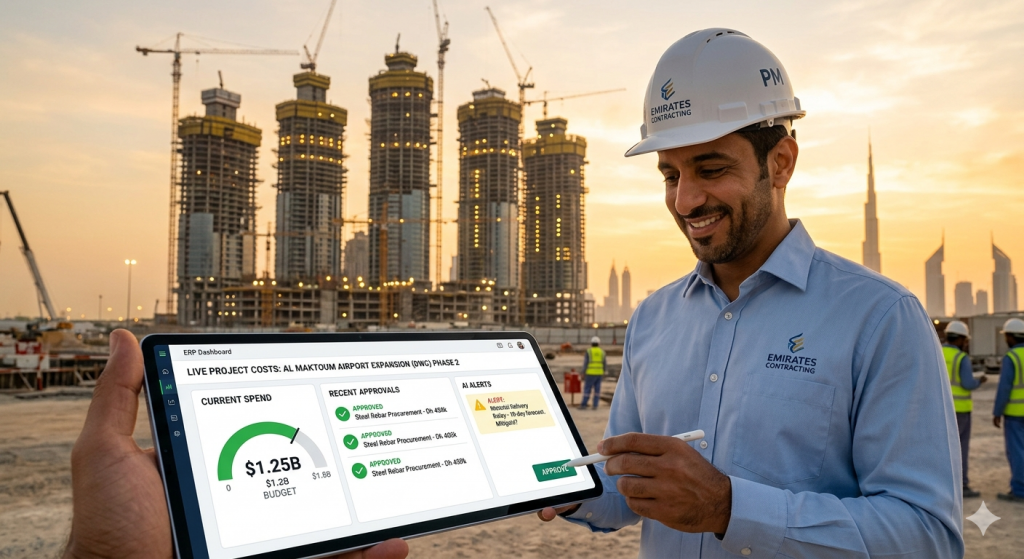
The before-and-after of Agentic ERP isn’t just a feature comparison table. It’s a shift in
how the company experiences itself.
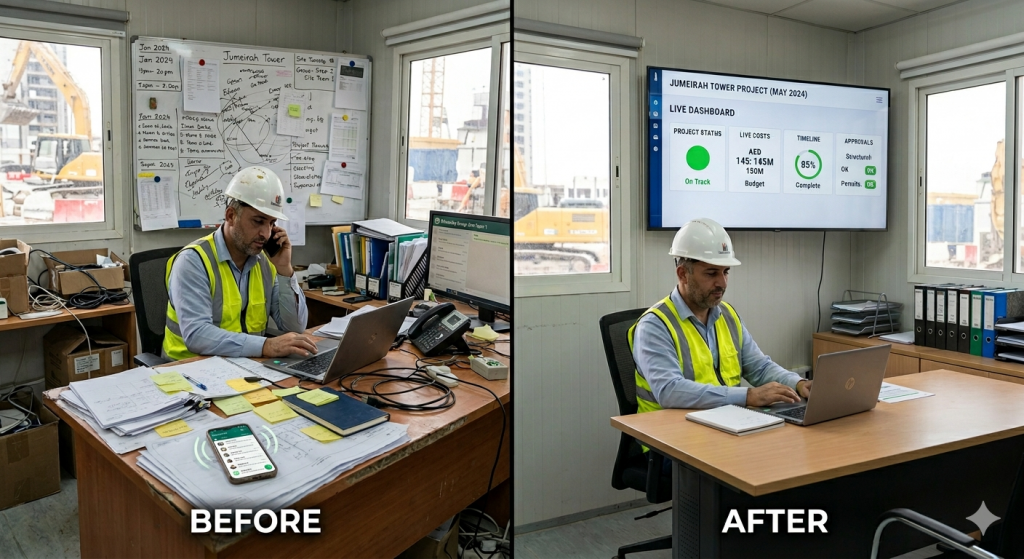
Before: The Reactive Company– Every Monday starts with confusion. Reports are assembled from memory and last week’s data. Decisions are made based on whoever had the latest update in their head. The leadership team spends more time chasing information than acting on it. Key people are overloaded because everything flows through them. The business grows, but the chaos grows faster.
After: The Signal-Driven Company– Monday morning starts with a dashboard that was updated overnight. The leadership team walks in knowing what happened, what’s at risk, and what needs a decision. The operations team gets automatic briefings. The finance team has real numbers. And the ERP + AI layer has already handled the routine — leaving the humans to handle the judgment calls that actually need human judgment.
In the UAE market specifically, this matters for a few reasons that are particular to how
business works here:
• Regulatory complexity: VAT, WPS, Ministry of Labour compliance, municipality permits — the paperwork burden in UAE construction is genuinely significant. Agentic ERP automates the routine compliance tasks and flags the exceptions, reducing both workload and risk.
• Multi-nationality workforce: Managing HR for teams of 10+ nationalities with different visa requirements, leave rules, and payroll structures is a genuine operational challenge. A unified HR module with AI-assisted processing removes the coordination overhead.
• Project-based billing: UAE construction contracts often have complex milestone and retention billing structures. Agentic ERP tracks these automatically, generates invoices at the right time, and never misses a payment milestone — which, given typical contract values, is worth a lot.
• Subcontractor ecosystem: Most UAE contractors work with 20–50 active subcontractors at any time. Managing their LPOs, compliance documents, invoices, and payments manually is a full-time job for two people. It doesn’t have to be.
📊 What the Numbers Look Like: SummitCode clients typically see 40% reduction in manual processing hours within the first 90 days, real-time margin visibility replacingmonthly surprises, and procurement cycle times dropping from 5–7 days to same-dayapprovals. These aren’t aspirational figures — they’re what happens when you remove the friction.
The 90-Day Path — Surprisingly Manageable
One of the most common objections is: “We’ve tried ERP before and it was a disaster.”
Fair. Most ERP implementations fail not because ERP doesn’t work, but because implementations are badly scoped, badly managed, and dropped on teams without proper change management.
SummitCode’s approach is different specifically because it’s designed for operating companies — not IT departments. The 90-day roadmap is built around business outcomes, not software features:
• Weeks 1–3: Data audit, system configuration, core module setup
• Weeks 4–6: Team onboarding, live dashboards, first automations running
• Weeks 7–10: AI agents deployed on highest-value workflows
• Weeks 11–13: Full Agentic ERP live, team operating independently, optimization begins
The key difference: SummitCode doesn’t just implement software. They map your actual operating workflows first, configure the system around how your business works (not around a generic template), and train your team on the logic — not just the buttons. The AI agents are built on your real data, not a demo environment.
“A company that runs itself.” That’s the language on their website, and it’s not marketing copy. It’s a reasonable description of what Stage 3 looks like for an operations team that’s been through this properly.
Is This for You?
If any of the following sounds true, the answer is probably yes:
✅ You have between 20 and 500 employees and you know your operations don’t scale cleanly.
✅ You’re generating AED 5M+ in revenue but your reporting is still a manual, delayed process.
✅ Key decisions in your business wait for one or two people who hold all the context.
✅ Your team is hardworking but buried in coordination overhead and data admin.
✅ You’ve thought about ERP before but been put off by the cost, complexity, or memories of a failed attempt.
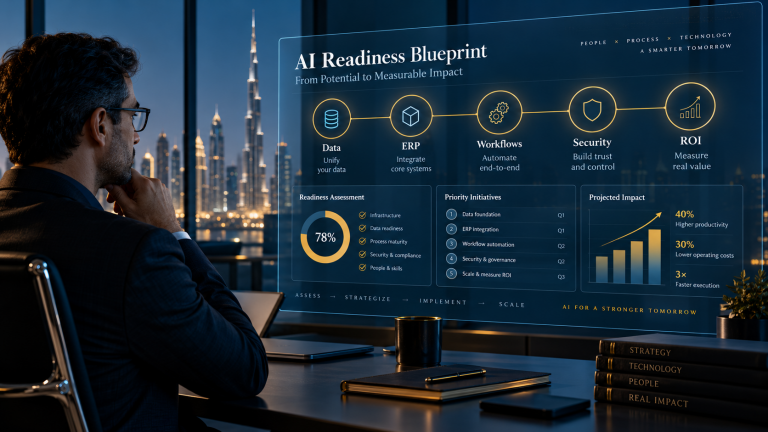
SummitCode offers a free CEO-level readiness assessment — a short questionnaire that gives you a practical operational maturity score, tells you exactly where your business is losing time and money, and recommends where to start. No sales pitch required upfront. Just a clear, honest picture of where you stand.
🚀 Start Here: Take the free Agentic ERP Readiness Assessment — get your score on screen and a recommendation for where the biggest operational leverage is hiding in your business.
The Bottom Line
Khalid — our operations director from the opening — went through this process. Ninety days later, his Monday mornings look different. He still arrives early. The problems haven’t all disappeared (it’s construction; problems are part of the deal). But now, the system surfaces the problems before they become crises. The decisions arrive with context, not confusion. The reports write themselves. The follow-ups send themselves.
He still puts out fires. But he chooses which fires to put out — and he doesn’t find out about them three weeks after they started.
That’s what an operating system feels like, versus running on duct tape.
Your business doesn’t need more tools. It needs a nervous system.
It takes 90 days to build one. The question is just whether you start today.
WhatsApp vs Construction Software: FAQ
Is WhatsApp construction software?
No. WhatsApp is a messaging app. It has no job-cost ledger, no LPO approval workflow, no retention tracking, and no audit trail — a voice note is not a record. Construction software, or better a unified Agentic ERP, is a system of record: every site request, LPO, delivery, subcontractor invoice, and payment certificate lives in one place, linked to a project and a cost centre. See how SummitCode approaches construction operations.
Why does running a contracting business on WhatsApp and Excel fail for job costing, LPOs, and retention?
Because chat has no structure. An approval given in a voice note cannot be matched to a purchase order, a screenshot cannot update a budget, and a retention amount buried in a thread is invisible at month-end. Excel then becomes the manual bridge between chat and finance — and it is always days behind the site. By the time an overrun shows up in the sheet, the margin is already gone.
What should UAE contractors use instead of WhatsApp for site and project updates?
One operating system for the whole business: project costing, procurement (site request to LPO to delivery to invoice), subcontractor management, finance, and HR in a single place — with a simple mobile form for site teams so updates land in the system instead of a group chat. SummitCode delivers this as Agentic ERP, configured for UAE construction companies.
How is Agentic ERP different from just another ERP?
A traditional ERP stores and reports; someone still has to log in and act. Agentic ERP adds AI agents on top of the unified backbone that read context and move work forward: matching subcontractor invoices to POs, routing LPO approvals, flagging a project drifting over budget before month-end, and drafting supplier follow-ups. The system does the chasing; your team makes the decisions.
Does this also cover UAE VAT and WPS?
Yes, though compliance is a by-product of the switch rather than the reason for it. Once projects, procurement, and payroll run through one system, VAT-ready invoicing, WPS payroll files, and audit trails come out of the same data instead of being rebuilt in Excel every month. SummitCode's UAE compliance overview covers the detail.