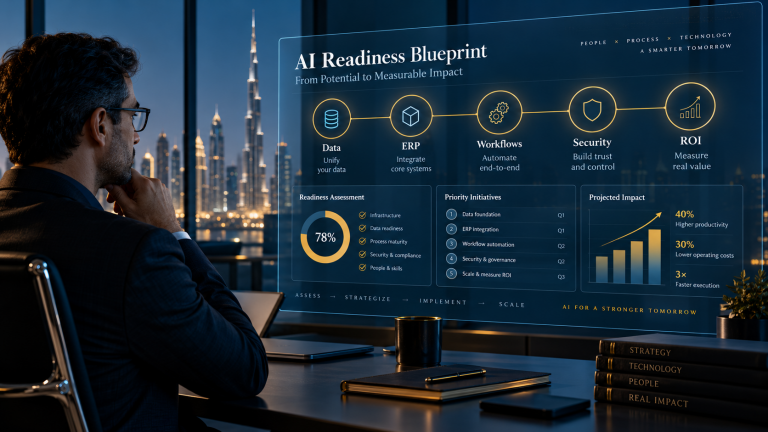
It is 7:43 AM. Your warehouse supervisor just messaged to say the chiller truck is delayed. A retailer in Abu Dhabi is asking where yesterday’s delivery is. Your accountant needs the VAT reconciliation for last quarter and three batches of yoghurt are hitting their expiry date in 72 hours.
You have not had your coffee yet.
Welcome to the food business.
FMCG and food distribution might just be the most operationally demanding sector an SME can operate in. You are managing perishables, supplier credit terms, retailer payment delays, Halal certifications, Dubai Municipality approvals, cold chain compliance, batch traceability, and a sales team that still logs visits in a notes app. All at the same time. All with urgency.
And at the centre of all of it, holding it together with sheer determination and institutional memory — is usually one person. Maybe two.
This article is not about selling you software. It is about helping you see what your operations could actually look like. And more practically — what the path from where you are now to where you want to be actually looks like, step by step.
—
First, Let Us Talk About What Is Actually Breaking
Here is the uncomfortable truth about most FMCG SMEs in the UAE: the chaos is not caused by bad people or bad intentions. It is caused by growth without systems. You built the business fast — because you had to — and the tools you used were good enough to get you here. Spreadsheets, WhatsApp, phone calls, and a very talented operations person who remembers everything.
The problem is that “good enough to get you here” is not “good enough to take you there.”
Let us be specific about what is breaking.
You do not have real-time stock visibility. Your warehouse knows what it has. Your sales team does not. So they promise retailers stock that has already been committed elsewhere, or worse, they discover on delivery day that the batch expired. The ensuing conversation is not pleasant.
Batch and expiry tracking is a manual nightmare. Someone maintains a sheet. The sheet is either out of date or only one person truly understands it. FEFO (First Expired, First Out) is the rule — but in practice, it depends on who picks the goods and how their morning went.
You are giving credit to retailers and losing track of it. LuLu wants 60-day terms. A Sharjah supermarket chain wants 45 days. A quick-service restaurant group pays when they feel like it. Your receivables are a foggy mess, and chasing outstanding invoices is a part-time job your team has acquired by accident.
Supplier management is reactive.You reorder when you run low — not based on lead times, sales trends, or projected demand. The result? Overstock on slow lines and stockouts on your bestsellers, usually at the same time, usually right before Ramadan.
Your VAT position on food items is unclear. Some products are zero-rated. Some are standard-rated at 5%. Mixed baskets create complexity. And when the FTA wants to audit, you need clean records that took you three weeks to prepare manually.
Your finance picture is always a month behind. You know revenue is happening. You do not know if you are making money until someone finishes the reconciliation — by which time the decisions have already been made on gut feeling.
—

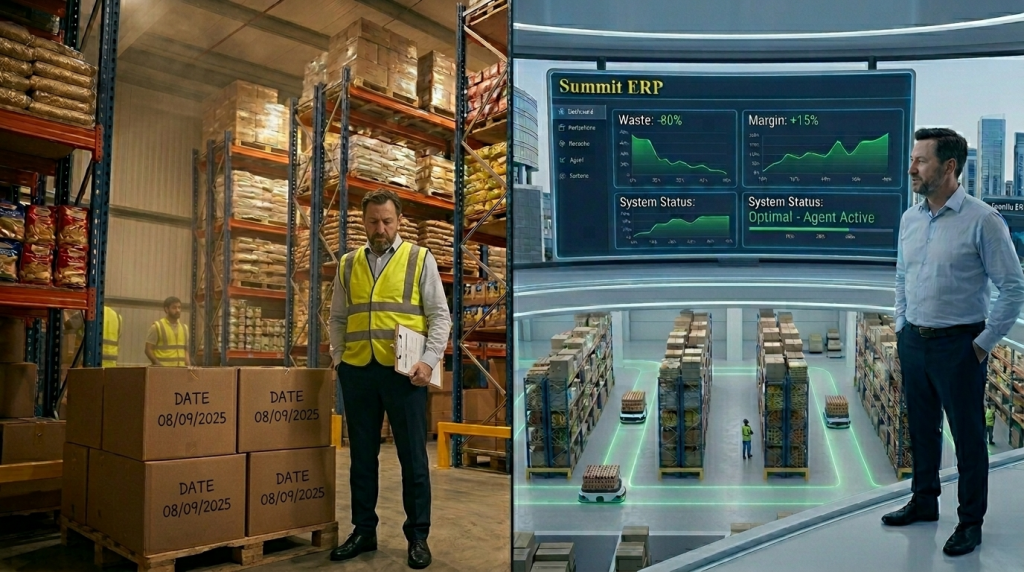
Before and after isn’t just about software. It’s about how your mornings feel.
—
Why FMCG Is a Harder Problem Than Most
Here is what makes food and FMCG genuinely different from, say, a professional services firm or a trading company.
Product complexity. A single brand might carry 80 SKUs — different sizes, variants, flavours, pack configurations. Each one has a different cost, margin, expiry cycle, and supplier. Managing that in spreadsheets is not a workflow, it is a hobby.
Regulatory weight. Dubai Municipality food registration. ESMA product approvals. Halal certificates with expiry dates. Import permits that need renewal. Country-of-origin documentation for each shipment. If any one of these lapses, your products sit in a port somewhere while the paperwork catches up. And the clock is ticking on the expiry.
Margin compression. Food is a low-margin business. Every point of waste — spoilage, overproduction, incorrect deliveries, returned goods — eats directly into what little margin you have. You cannot afford to be imprecise. But without real-time data, precision is impossible.
Seasonality that is non-negotiable. Ramadan changes everything. Eid changes everything. The summer slowdown in some categories, the winter peak in others. If your demand planning is based on last year’s WhatsApp messages, you are going to get caught out.
Distributor and retailer dynamics. You are simultaneously managing supplier relationships upstream and retailer relationships downstream. Both sides have power. Both sides have terms. Sitting in the middle requires information you often do not have fast enough.
The point is: the food business is not crying wolf when it says it needs better systems. The complexity is real. The margin for error is genuinely thin.
—
Stage 1: Get Your Foundation Right (Because AI Cannot Fix a Mess)
There is a version of this conversation that goes straight to AI and agents and automation. That version tends to disappoint people six months later.
Here is why: AI is only as good as the data it sits on. If your stock data is unreliable, your AI agent will confidently give you wrong numbers at twice the speed. If your customer records are duplicated and scattered, your agent will follow up with the wrong contact about the wrong invoice.
The single most important thing you can do for your FMCG business — before anything intelligent can happen — is build one clean source of truth.
For food and FMCG businesses specifically, this means an ERP foundation that handles:
Inventory with Batch and Expiry Tracking. Every item in your warehouse has a batch number, an expiry date, and a FEFO-compliant pick sequence. Not in a sheet. In the system. Automatically.
Multi-Warehouse Visibility. Dubai warehouse, Abu Dhabi hub, the chiller section, the ambient section, the returns bay — all visible from one dashboard. Stock transfers happen in the system, not over WhatsApp.
Supplier Management with Lead Times. Each supplier has their actual lead time, payment terms, and order minimums recorded. Reorder points are set based on sales velocity, not memory.
Customer Credit Control. Every retailer’s credit limit, outstanding balance, and overdue days are visible. Your sales team cannot confirm an order to a customer who is 30 days over their credit limit — because the system flags it before they can.
VAT-Correct Sales and Purchasing. Zero-rated items, standard-rated items, mixed invoices — all handled correctly and consistently. Your VAT 201 report does not require three people and a weekend to prepare.
Live P&L and Margin Visibility. Not month-end. Not when your accountant has time. Now. Margin by product line, by customer, by channel — visible on demand.
This is what a well-configured Summit ERP foundation gives you. It is not glamorous. Nobody posts about it on LinkedIn. But it is the difference between running a business and managing organised chaos.
How long does it take to set up? With the right team: 20 to 45 days for an established FMCG business with existing data. Not a year. Not six months. Forty-five days.
—
Stage 2: Agentic ERP — When Your System Starts Doing the Work
Now it gets interesting.
Once your data is clean, your processes are in one place, and your team is working from a single system — you are ready to layer AI on top. Not a chatbot. Not a button that says “summarise this.” A genuine agentic layer that reads your business, understands context, and takes action.
Here is what that looks like in a real FMCG operation.
—
“Which batches are expiring in the next 30 days?”
The agent pulls your entire inventory, filters by expiry date, and surfaces a prioritised list with quantities, locations, and current retail demand for each item. It calculates the realistic sell-through window for each batch and flags any where the maths does not work.
Then it offers next steps: push promotional pricing to reduce stock? Create a return-to-supplier request? Flag for donation? Your call. Its job was to surface the problem before it became a write-off.
——
“Prepare my VAT filing for last quarter.”
The agent knows your VAT registration details, your current period, and exactly which reports to pull. It walks you through the VAT 201 preparation — Sales Register, Purchase Register, input tax, output tax — flags any anomalies it spots, and gives you direct links to EmaraTax for submission.
Your accountant used to spend a day and a half on this. Now it takes 20 minutes and a few taps.
—
“Which customers are more than 30 days overdue?”
The agent pulls your accounts receivable ageing, filters by overdue threshold, sorts by outstanding amount, and drafts personalised follow-up messages for each customer — already written, already accurate, waiting for your approval before sending.
You review. You tap approve. The follow-ups go out. And your collections team did not have to manually compile the list, draft the messages, or remember who they already chased last week.
—
“Create a purchase order for our top five suppliers based on current stock levels.”
The agent checks current inventory against your reorder points, calculates the quantities needed based on current demand velocity and supplier lead times, and drafts five purchase orders — one per supplier, with correct pricing, currency, and terms.
You review each one. You approve. Done.
What used to take your purchasing manager two hours on a Tuesday morning now takes eight minutes.
—
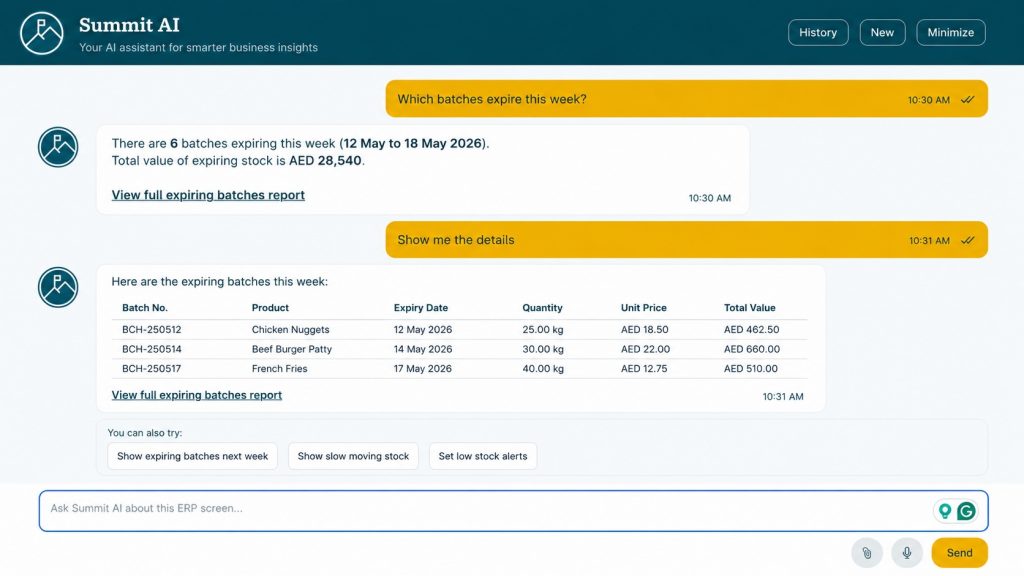
Your warehouse no longer has secrets. Your AI agent reads it so you don’t have to.
—
The pattern across all of these is the same: The AI does the heavy lifting, you make the final call. You are not removed from the process. You are elevated above the noise that was consuming your time and clouding your judgment.
Here is a snapshot of what the Agentic ERP layer handles across FMCG operations:
| Function | What the Agent Actually Does |
|---|---|
| Inventory | Flags expiring batches, calculates reorder quantities, surfaces slow-moving SKUs |
| Procurement | Drafts purchase orders based on demand, matches GRNs to POs on arrival |
| Sales & CRM | Follows up on open quotations, flags customers due for re-engagement, updates pipeline |
| Receivables | Prepares ageing reports, drafts collection messages, alerts on credit limit breaches |
| Finance | Prepares VAT packs, flags cash flow risks, pulls P&L on demand by product or channel |
| Compliance | Alerts when certifications (Halal, Municipality, ESMA) are due for renewal |
| Reporting | Produces any financial or operational report for any period, on demand, in plain language |
The operations manager who used to spend three hours every morning chasing these answers now spends twenty minutes reviewing what the agent has already prepared.
—
Stage 3: AI Coworkers — Your Operations Team, Extended
Here is where things shift from “impressive” to “genuinely transformative.”
Once your ERP is solid and your agentic workflows are running, you are ready to deploy AI coworkers — autonomous agents that do not just assist with tasks but own them end-to-end.
In an FMCG context, this is what that looks like in practice.
An AI Sales Development Rep that identifies which of your inactive retail accounts have not ordered in 45 days, researches their purchasing patterns, drafts a re-engagement message with a relevant promotional offer, sends it, and follows up. It books meetings for your human sales reps. It updates the CRM. It works every day, not just when your SDR remembers.
An AI Customer Support Agent that handles your retailer and distributor queries — order status, proof of delivery requests, product specifications, pricing confirmations — without pulling your operations team away from actual operations. Tier-1 questions are answered immediately. Complex issues are escalated to a human with full context already prepared.
An AI Demand Planning Analyst that pulls your sales data every week, compares it to last year, adjusts for seasonality (Ramadan uplift on certain categories, summer slowdown on others), and produces a forward-looking demand forecast that your purchasing team can actually use. No consultants. No separate forecasting tool. Just your own data, interpreted intelligently.
An AI Compliance Tracker that monitors every product registration, Halal certificate, Municipality approval, and import permit in your system — and alerts the right person thirty days before anything expires. Because finding out your approval lapsed on the day of a customs inspection is a very expensive lesson.
The economics are not difficult to justify. A junior operations coordinator in the UAE costs somewhere between AED 7,000 and AED 14,000 per month. An AI coworker that handles equivalent workload starts at a fraction of that — and it does not take sick leave during peak Ramadan season, does not resign when a competitor offers an extra thousand dirhams, and does not forget to send the follow-up.
More practically: it frees your actual team to do the things that genuinely require human judgment — supplier negotiations, key account relationships, quality decisions, growth strategy.
—
What Does Life Actually Look Like After?
Let us paint the picture, because this is the part that matters.
Your operations manager starts the day by reviewing what the system has already prepared — not chasing what it has not. Expiring batches are already flagged with recommended actions. Overdue customer accounts already have draft follow-ups waiting for approval. Purchase orders are prepared and queued. The day’s delivery schedule is confirmed against actual stock, not hoped-for stock.
Your finance team closes the month in two days instead of two weeks. VAT is prepared in a morning. The P&L is not a mystery at the end of the month — it has been visible all month, updated in real time.
Your sales team knows exactly which customers they should call today, which ones are at credit risk, and which product lines have the best margin to push. They are not guessing. They are reading a system that knows.
Your MD opens a dashboard in the morning and actually knows how the business is doing — margin by product, stock health, receivables position, pending compliance renewals. In two minutes. Before the first meeting.
That is not a fantasy. That is what a business running on a proper Agentic ERP looks like. And in the food sector — where the margins are thin, the regulatory pressure is constant, and the operational demands are relentless — that kind of clarity is not a luxury. It is survival infrastructure.
—
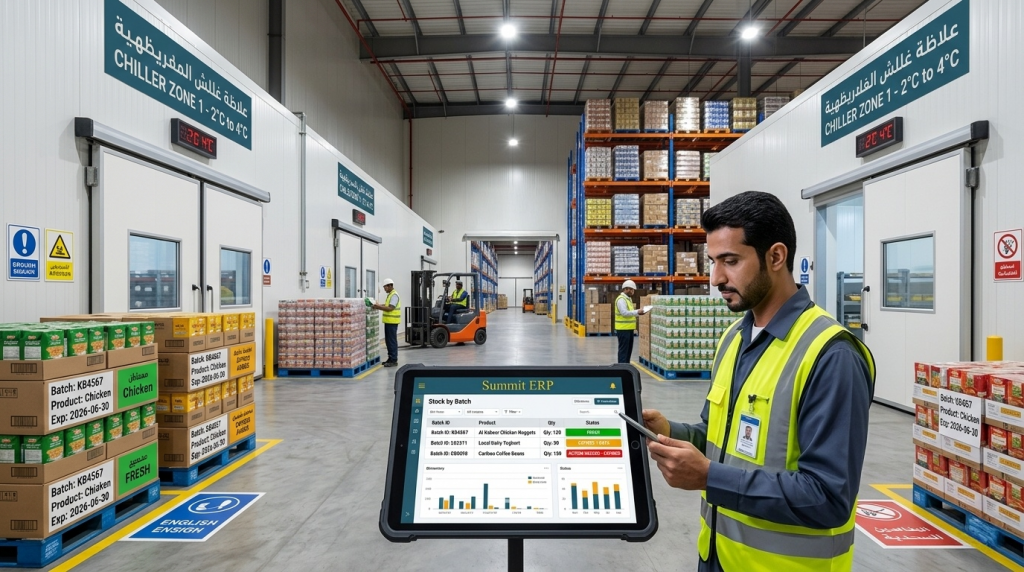
When your system knows the shelf life of every batch in your warehouse, you stop finding out the hard way.
—
The 90-Day Path for FMCG Businesses
Here is what a realistic implementation looks like for an established food distributor or manufacturer.
Days 1 to 30: ERP Foundation
Summit ERP is configured for your specific FMCG setup — inventory with batch and expiry tracking, multi-warehouse, supplier management, customer credit control, and VAT-correct accounting. Your data is migrated. Your team is trained. For the first time, everyone is working from one system.
Days 31 to 60: Agentic ERP
The AI layer goes live. Your first agentic workflows are running — expiry alerts with recommended actions, automatic receivables follow-ups, demand-based purchase order drafting, and on-demand financial reporting. Manual hours start dropping immediately, visibly, measurably.
Days 61 to 90: AI Coworkers
Your first autonomous agent is deployed. Depending on where your biggest pain is, this might be an AI sales rep re-engaging dormant accounts, an AI compliance tracker monitoring certification expiry, or an AI analyst producing weekly demand forecasts. It starts in supervised mode, then goes fully operational.
By day 90, you have not just implemented software. You have changed how your business operates.
—
A Practical Word Before You Decide Anything
The FMCG sector in the UAE is genuinely competitive. Large regional distributors and multinationals have had structured systems for years. The reason smaller importers, manufacturers, and distributors have been able to compete is a combination of flexibility, relationships, and hustle.
But hustle has a ceiling. Relationships do not scale. Flexibility without data becomes guesswork.
The businesses that will pull ahead in the next three years are not necessarily the ones that grow fastest. They are the ones that get operationally smarter fastest — that can see their margin clearly enough to price correctly, track their stock closely enough to avoid waste, and move fast enough to capitalise on opportunities while competitors are still pulling a report.
Agentic ERP is not about replacing your people. It is about making your people genuinely effective — removing the administrative weight that currently consumes their best hours, and giving them information they can actually act on.
—
Where to Start
Before you invest a dirham in implementation, it is worth knowing exactly where you stand.
SummitCode offers a free Agentic ERP Readiness Assessment — a short CEO-level quiz that gives you a clear score across visibility, automation, process dependency, and operational maturity. You get your result instantly, along with an estimate of how many manual hours your team is currently losing per week.
If you would rather talk through your specific situation first:
Book a 15-Minute Call with the SummitCode Team
—
SummitCode is an AI transformation specialist based in the UAE, combining ERP implementation experience with agentic AI design, integration engineering, and founder-level operating judgment. 35+ projects delivered. 8+ ERP engineers. 90 days to your first AI operating system.