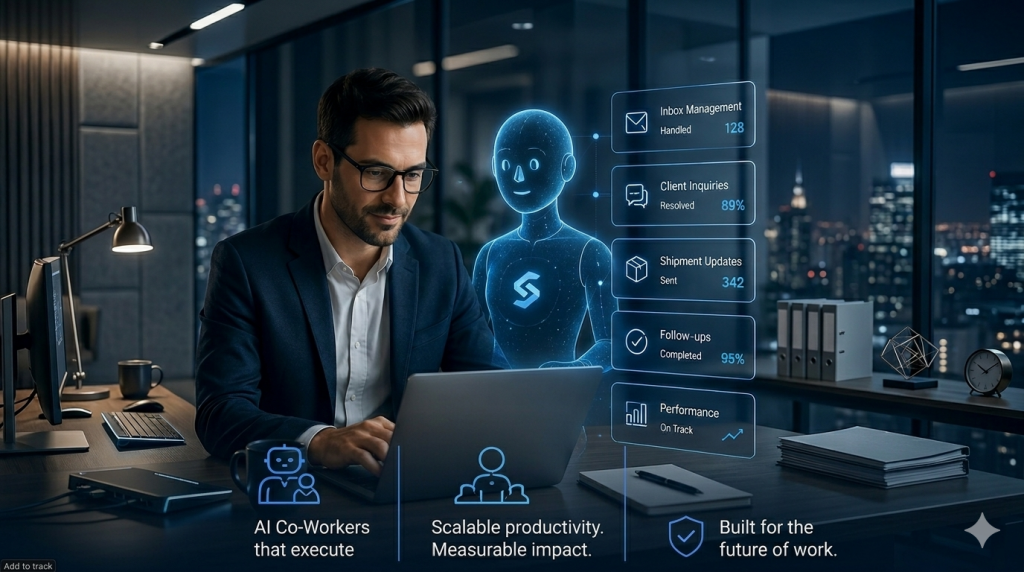
The gap between businesses deploying AI Co-Workers and those still running pilots is no longer a matter of months. As of Q2 2026, it is a structural competitive divide — and it is widening every week.
The State of Play · April 2026
This is no longer a forecast. As of this week, 97% of executives report that their company has deployed AI agents in the past year. The market hit $10.9 billion. EY just announced a global program to retrain 130,000 auditors to work alongside AI agents. The experiment is over. The deployment era has arrived.
Four days ago, a digest published by workforce intelligence firm Asanify put it plainly: “For HR leaders, this is the clearest signal yet that agentic AI is moving from ‘interesting experiment’ to ‘mandatory infrastructure.’ If a Big Four firm is retraining 130,000 people to work alongside AI agents, ask yourself: what does your organization’s AI upskilling plan look like?” That question is no longer abstract. It is the defining business question of Q2 2026.
The Federal Reserve Bank of Atlanta published research this March — drawing on nearly 750 corporate executives — confirming that labour productivity gains from AI are positive, vary across sectors, and are expected to strengthen throughout 2026, with the largest effects concentrated in high-skill services and finance. These are not projections from AI vendors. This is a central bank study.
“AI isn’t just an investment — it’s becoming the backbone of enterprise strategy. The leaders are scaling fast and pulling ahead. The laggards are stalling after early deployments and losing ground that may not be recoverable.”
Steve Chase — Vice Chair, AI & Digital Innovation, KPMG LLP · January 2026
The Numbers That Define This Moment
The WRITER 2026 Enterprise AI Adoption report, published two weeks ago from a survey of hundreds of senior leaders, found that AI super-users — the roughly 20% of employees who have genuinely learned to deploy agents — are delivering 5× productivity gains. Not 5%. Five times. The problem, as the report notes, is structural: only 29% of organisations are translating those individual wins into meaningful company-wide ROI. The gap is not in the technology. It is in the system around the technology.
| 97% Of executives deployed AI agents in the past year — WRITER, Apr 2026 | 5× Productivity gains by AI super-users — WRITER Enterprise AI 2026 | $10.9B AI agent market size in 2026, growing 45%+ annually — Zemith | 80% Of deploying enterprises report measurable economic benefit — AI Business Mag, Apr 2026 |
Nvidia’s State of AI 2026 report, published March 19, found that 44% of companies were deploying or assessing agents by year-end 2025 — and that by early 2026, those experiments had “become full-fledged deployments, touching everything from code development to legal and financial tasks, administrative support and more.” The AI agent market is growing at a 61.5% compound annual rate. Gartner’s standing prediction — that 40% of enterprise applications would embed task-specific agents by year-end 2026 — is now widely regarded as conservative.
“The future of AI is not a robot. It’s a team. Companies are rapidly transitioning to an orchestrated workforce model — where a primary orchestrator agent directs smaller, expert agents. Humans remain in control, shifting to a high-level supervisory role.Armita Peymandoust “
SVP, Forward Deployed Engineering, Salesforce · 2026
What Actual Deployment Looks Like in 2026
The evidence is no longer theoretical. It is appearing in operational reports, earnings calls, and regulatory filings. Here is what is being deployed right now:
EY — Professional Services . 4 days ago
130,000 auditors being retrained to work alongside AI agents in a global 2026 programme.
One of the world’s largest professional services firms is not piloting AI at the margins. It is restructuring the entire audit function around human-agent collaboration. EY has also joined Stanford’s Human-Centered AI Industrial Affiliates Program as part of this effort, embedding academic rigour into its agent governance model. The programme is running throughout 2026.
PepsiCo + Siemens + NVIDIA — Manufacturing March 2026
AI agents running digital twins of US factories — 20% throughput increase on initial deployments, 10–15% capex reduction.
PepsiCo converted selected US manufacturing and warehouse facilities into physics-accurate 3D digital twins, with AI agents simulating and refining system changes before any physical modification. The result: agents identifying up to 90% of potential issues pre-implementation, faster design cycles with near-100% design validation, and measurable throughput gains. This is agentic AI as operational infrastructure — not experimentation.
Financial Services — Sector-wide Deloitte State of AI, 2026
Loan approval cycle cut from days to hours. Meeting action capture and follow-through automated end-to-end.
Deloitte’s 2026 State of AI in the Enterprise report documents financial services firms building agentic workflows to automatically capture meeting commitments from video conferences, draft reminder communications, and track follow-through — without any human administrative involvement. Separately, AI agents are compressing loan approval cycles from multi-day processes to sub-hour workflows by handling end-to-end data ingestion, cross-referencing, and exception routing.
Canva — Creative Platform April 2026
AI 2.0 launch: agentic orchestration, cross-platform memory, and connectors to Slack, Notion, Zoom, Gmail — 7× faster, 30× cheaper than frontier models.
At its Create 2026 event this month, Canva unveiled its biggest product overhaul since launch. The platform now supports conversational design from natural language prompts, agentic orchestration across its design engine, and a Memory Library that retains brand preferences across sessions. The company claims its proprietary agents run 7× faster and 30× cheaper than comparable frontier alternatives. Consumer-grade creative tools are now agentic by default.
The Divide That Is Opening Up — Right Now
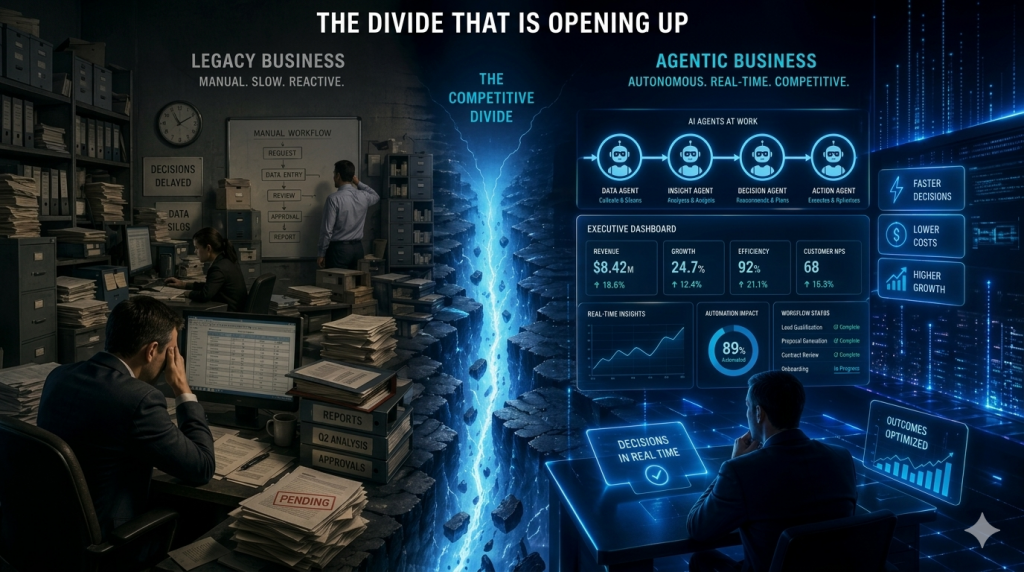
Here is what the data shows when you look past the headline adoption figures. AI usage is nearly universal: 91% of businesses report using AI in at least one capacity in 2026. But universal access is producing wildly uneven outcomes. The WRITER report documents a stark paradox: workers report 40% individual productivity boosts, yet 80% of companies see no measurable bottom-line change.
This is not a technology failure. It is a system failure. The AI is working. The organisations are not structured to capture what the AI produces.
“AI transformation is ultimately about people. The future belongs to the companies putting agent-building power directly into the hands of people closest to the work — not the ones running disconnected experiments that never touch core systems.”
May Habib — CEO & Co-Founder, WRITER · April 2026
Deloitte’s 2026 State of AI confirms the same pattern: worker access to AI rose 50% in 2025, and the number of companies with more than 40% of AI projects in production is set to double within six months. But only one in five companies has a mature governance model for autonomous AI agents. The infrastructure is being built faster than the management capability to run it.
| Companies with agents in production Set to double in the next 6 months — Deloitte 2026 | Companies with mature agent governance Only 1 in 5 — Deloitte State of AI 2026 |
| Organisations feeling no bottom-line impact 80%, despite near-universal AI adoption — WRITER 2026 | AI super-user productivity multiplier 5× — but only 20% of workers reach this level — WRITER 2026 |
Why the “Treat It Like a Tool” Approach Is Failing
The organisations stuck at zero bottom-line impact share a common failure mode: they deployed AI agents the way they deploy software — through IT, via a vendor ticket, with a license key and a brief onboarding deck. No role definition. No daily workflow mapping. No success metrics. No feedback loop.
Deloitte’s February 2026 research articulates the root cause precisely: enterprises are “trying to automate existing processes — tasks designed by and for human workers — without reimagining how the work should actually be done.” They are layering agents onto legacy workflows and wondering why nothing changes.
The businesses capturing the 5× productivity multiplier are doing something different.
They are treating agent deployment like a hire, not a software rollout. They define the role before they write a configuration. They map the daily workflow. They establish KPIs. They run a shadow mode period before the agent touches live work. They have a feedback mechanism. They monitor. They improve. This is talent management, not IT procurement — and most businesses have no playbook for it.
This is the gap that SummitCode CoWork was built to close. The platform is structured around the same discipline that separates successful agentic deployments from failed ones: deep role discovery before any infrastructure is touched. The four-phase process — Role Discovery, Agent Architecture, Training & Testing, Deploy & Improve — is not a product journey. It is an onboarding methodology, borrowed from how great companies hire great people.
Value doesn’t come from launching isolated agents. 2026 is the year we begin to see orchestrated, governed systems that drive measurable outcomes — and the winners will be the ones who professionalised their agents first.”
Swami Chandrasekaran — Global Head of AI & Data Labs, KPMG · January 2026
What a Real Deployment Looks Like in Practice
A 15-person logistics brokerage in Dubai. One account manager handling all client communications — WhatsApp, email, Slack. Volume is manageable today. They have just signed contracts to open two new corridors into Africa. Volume will triple in 90 days.
With SummitCode CoWork, the founder onboards a Client Relations Co-Worker. He has a name — Kareem. His role is defined: handle all inbound freight queries, send proactive shipment updates at key milestones, escalate customs complications above a defined risk threshold to the human team, and follow up on quotes that have not converted after 48 hours. He has access to the company’s TMS, WhatsApp Business API, and Gmail. His KPI: 85% query resolution without escalation, average response under 3 hours.
Kareem runs in shadow mode for seven days. His pass rate lands at 81%. Two failure patterns are identified — he is not surfacing the correct ETD field from the TMS, and he is escalating price queries that the founder wants him to handle autonomously. Both are corrected in configuration. He re-runs. 89%. He goes live.
Six weeks later, the Africa corridors are live and running at full volume. Kareem handles 300+ client interactions per week. The account manager has been redeployed to business development — building the next two corridors. The company did not hire to scale. It deployed an agent and redeployed a human.
| 300+ Client interactions weekly, one Co-Worker | 89% Query resolution without human escalation | 7 days Shadow mode to live deployment | 0 New headcount hired to support 3× volume increase |
The Question Every Business Owner Has to Answer This Quarter
The McKinsey Agentic Organization report, referenced across the industry this year, found that 89% of organisations still operate on industrial-age models — linear, siloed, built for a world where every task requires a human worker. Only 1% operate as decentralised networks where intelligence flows freely and work is assigned based on capability, not headcount.
That 1% is growing — faster than most business leaders realise. And the compounding effect is significant. A business that has been running AI Co-Workers for six months has six months of agent memory, feedback loops, and performance data. Its agents are measurably better than they were at launch. A business that starts today starts from zero. That gap grows every week.
The SMB case is not the same as the enterprise case. You are not retraining 130,000 auditors. You are making a decision about one role, one workflow, one agent. The scope is human-scale. The impact — competitive capacity, operational headroom, the ability to grow without proportional hiring — is significant.
“Agentic AI for business operations is no longer an experiment reserved for technology-forward enterprises with seven-figure AI budgets. In 2026, it is the defining operational decision for business leaders across every industry.”
Sarfraz Nawaz — CEO, Ampcome · April 2026
The model question — proprietary versus open-source, Claude versus Llama 3, AWS versus Azure — matters far less than the role question. The businesses getting nothing from AI are not failing because they chose the wrong model. They are failing because they never defined what they needed the agent to do, how success would be measured, or what the daily workflow looked like. SummitCode CoWork makes those decisions unavoidable — by design.
The competitive window for first-mover advantage in your specific industry vertical is measured in quarters, not years. By the time an AI Co-Worker has six months of operational history in your business — knows your clients’ communication preferences, your product catalogue’s edge cases, your escalation thresholds — a competitor deploying today is six months behind. That gap is structural. It does not close on its own.
Start your first hire this week.
From job description to live, tested, deployed AI Co-Worker — guided end-to-end. No AI team required. No seven-figure budget. Just a role that needs filling.