Introduction: The ERP System That Finally Got Smart
Picture this: It’s 3 AM on a Tuesday. Your supplier in Southeast Asia just messaged that a critical shipment is delayed due to unexpected port congestion. In the old world, this message sits in someone’s inbox until morning. By the time your procurement team sees it, assembles a meeting, calls the supplier, checks inventory levels, identifies alternative suppliers, gets approval for expedited shipping, and updates fifteen different stakeholders across finance, operations, and sales—well, you’ve lost two days and probably a few customers.
Now imagine a different scenario. That same 3 AM message arrives, but this time, an autonomous AI agent immediately springs into action. Within minutes, it’s assessed your inventory buffer, identified which orders are at risk, contacted three alternative suppliers with your specifications, negotiated expedited terms within your budget parameters, rerouted the shipment, updated your ERP forecasts, adjusted your production schedule, notified the relevant stakeholders with a concise summary, and even drafted customer communications for your sales team to review. By the time your procurement manager logs in at 9 AM with their coffee, the crisis has been contained, costs minimized, and a full report is waiting in their inbox.
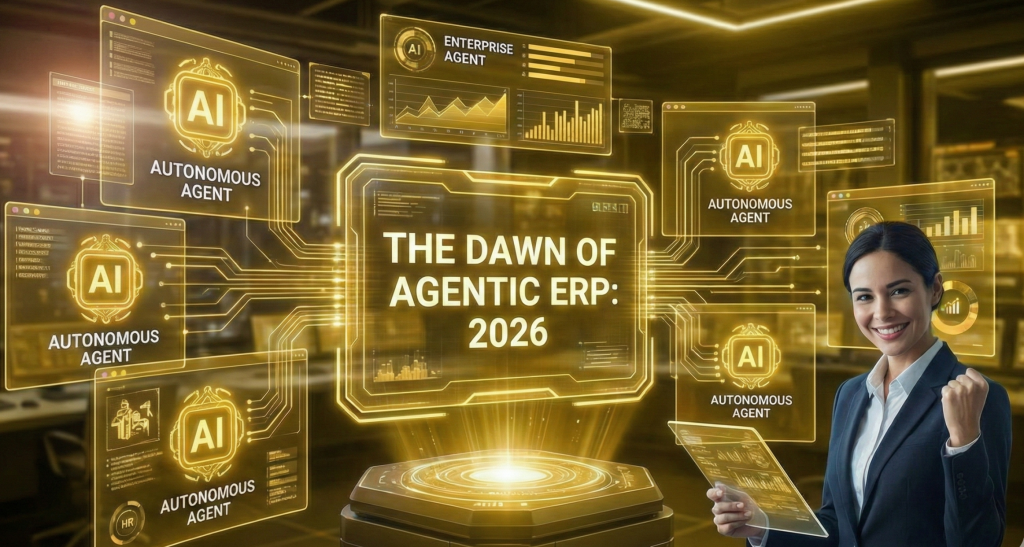
This isn’t science fiction. This is agentic ERP in 2026.
I’m thrilled to launch SummitCode’s first blog post, and I can’t think of a better topic to kick things off than the transformation we’re witnessing—and actively building—at the intersection of autonomous AI agents and enterprise resource planning. At SummitCode, we’re not just observers of this revolution; we’re empowering IT professionals and enterprises to harness it through our AI-driven solutions, from custom development in SummitCode Labs to hands-on training in our Academy, to products like SummitCode Voice that put agentic principles into action.
For too long, the AI conversation in enterprise has been dominated by chatbots that can’t quite understand your question and copilots that still need you to do all the heavy lifting. Meanwhile, your ERP system—the backbone of your operations—has been treated like the dependable but uninspiring middle child of the tech stack. That’s about to change dramatically.
Welcome to the era of agentic AI, where autonomous agents don’t just assist—they execute, adapt, and transform enterprise operations from reactive firefighting into proactive orchestration.
What Is Agentic AI—and Why Is 2026 Its Breakthrough Year?
Let’s get definitional for a moment (I promise to keep it interesting). Agentic AI represents a fundamental shift from the reactive tools we’ve grown accustomed to—your chatbots, your basic automation scripts, even your sophisticated-but-passive copilots—to autonomous agents that can perceive their environment, reason about complex situations, plan multi-step actions, execute those plans, and learn from the outcomes.
Think of it this way: traditional AI is like having a really smart intern who can answer questions when asked but needs constant supervision. Agentic AI is like having a seasoned colleague who understands the business context, can work independently on complex projects, knows when to escalate issues, and actually gets stuff done while you sleep.
The Perfect Storm of 2026
Several trends have converged to make 2026 the inflection point for agentic AI in enterprises:
Multi-Agent Orchestration Has Matured: Early attempts at autonomous agents often tried to build a single “super agent” that could do everything—and promptly fell flat on their digital faces. The breakthrough has been realizing that teams of specialized agents, each excellent at specific tasks and able to collaborate, mirror how actual high-performing teams work. Your procurement agent talks to your inventory agent, which coordinates with your logistics agent, which updates your finance agent. Just like your actual departments should work (but with less time wasted in meetings).
The Infrastructure Finally Exists: Foundation models have become sophisticated enough to handle complex reasoning. APIs have proliferated across enterprise systems. Vector databases make organizational knowledge accessible. Orchestration frameworks have emerged to manage agent workflows. The plumbing that agents need to function reliably in production environments is finally mature.
Enterprises Are Actually Ready: According to McKinsey research, 23-39% of enterprises are now actively scaling or experimenting with AI agents—up from single digits just two years ago. Gartner predicts that 40% of enterprise applications will feature task-specific agents by the end of 2026, compared to less than 5% in early 2025. More strikingly, they forecast that 15% of daily work decisions will be made autonomously by AI agents by 2028.
The Business Case Is Undeniable: Early adopters are reporting 30-50% acceleration in key workflows, dramatic reductions in errors from manual data entry and process handoffs, genuine 24/7 operational capability, and measurable cost savings that go straight to the bottom line. When your CFO sees those numbers, suddenly “experimental AI project” becomes “strategic priority.”
Beyond Automation: Why Agents Are Different
Here’s what makes agentic AI fundamentally different from the automation we’ve relied on for decades: traditional automation handles the predictable. You define the rules, map the workflow, and the system executes exactly as programmed. But what happens when the shipment is delayed? When the supplier quotes a price outside your parameters? When three things go wrong simultaneously in ways you never anticipated?
Traditional automation breaks. It escalates to humans. It waits.
Agentic AI adapts. It reasons about the situation using its understanding of business context, evaluates multiple approaches, makes decisions within defined guardrails, and keeps operations flowing. It handles the ambiguity and edge cases that make up so much of actual business operations.
The ERP Challenge—and How Agentic AI Finally Solves It
Let’s talk about the elephant in the room—or more accurately, the elephant in your data center. Your ERP system.
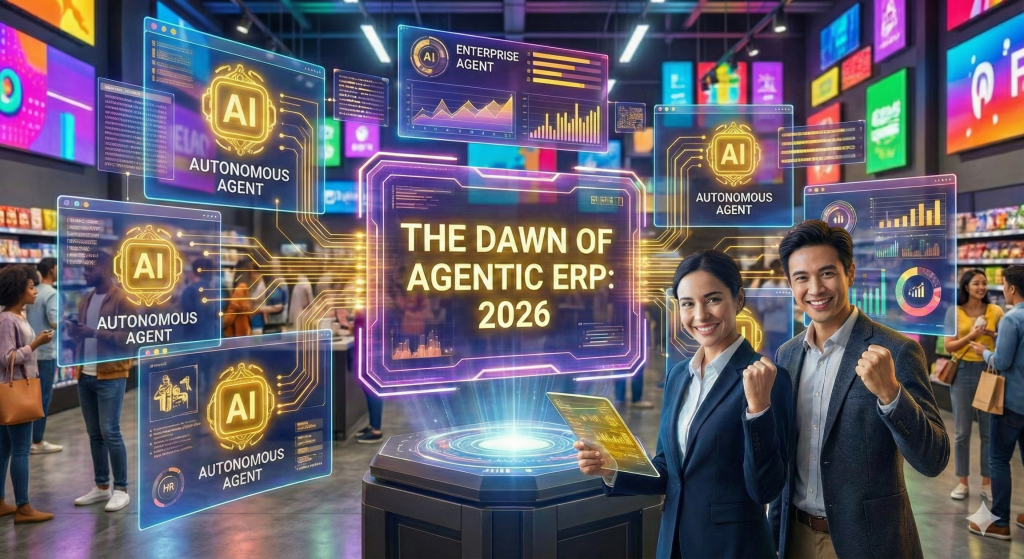
For all the excitement about AI transforming business, ERP has largely been treated as an afterthought in the conversation. Sure, vendors slap “AI-powered insights” onto their dashboards, but fundamentally, ERP systems remain what they’ve always been: sophisticated databases excellent at recording what happened, increasingly decent at reporting what’s happening now, but frustratingly passive about what should happen next.
Your ERP knows you’re running low on inventory. It knows a purchase order is overdue. It knows your cash flow projections are tight. But knowing and doing are very different things.
The Data Goldmine That Couldn’t Act
This has always been the paradox of ERP: these systems contain your organization’s most valuable operational data—every transaction, every inventory movement, every supplier relationship, every customer order, every financial metric—yet they’ve been essentially inert. They wait for humans to query them, analyze them, and then manually take action based on what they find.
It’s like having a brilliant analyst with perfect knowledge of your business who can only speak when spoken to and can’t pick up a phone or send an email to actually fix the problems they identify.
Enter Agentic Integration
This is where agentic AI transforms the equation. When you integrate autonomous agents with your ERP, you’re not just adding another reporting layer or a fancier dashboard. You’re fundamentally changing what your ERP can do.
Imagine these scenarios playing out in your systems right now:
Intelligent Procurement: Your procurement agent continuously monitors inventory levels, supplier performance, market pricing, and demand forecasts across your ERP. When it identifies an optimal buying opportunity—perhaps a preferred supplier has excess capacity and is offering favorable terms, coinciding with your projected needs in six weeks—it doesn’t generate a report for the procurement team. It initiates the negotiation, validates the terms against your policies, routes the contract for appropriate approval based on dollar thresholds, and once approved, executes the purchase order. All while documenting every step in your ERP for full auditability.
Adaptive Supply Chain: When your logistics agent detects a pattern—shipments from a particular carrier to a specific region have been delayed by an average of 3.2 days over the past month—it doesn’t wait for the quarterly supplier review meeting. It analyzes alternative routing options, calculates the cost-benefit of switching carriers for that lane, runs the change past your logistics policies, implements the switch for a trial period, and monitors the results. If performance improves, it makes the change permanent. If not, it reverts and tries another approach.
Proactive Finance: Your finance agent monitors cash flow patterns and notices that Customer X, historically prompt with 30-day payments, has shifted to averaging 47 days over the past quarter. Rather than waiting for this to hit the aging report and then the collections process, the agent cross-references against sales data (noting they’ve increased order volume by 35%), checks market news for the customer’s industry (finding that sector payment terms are stretching), drafts a personalized communication acknowledging the partnership and suggesting a structured payment plan that works for both parties, and routes it to your AR manager for review and sending.
The Real-World Results
Organizations implementing agentic ERP integration are seeing transformative results:
- Process Acceleration: Workflows that previously took days or weeks—requiring multiple handoffs, approvals, and manual data transfers—now complete in hours or minutes. The 30-50% acceleration figures being reported aren’t about working faster; they’re about eliminating the wait times between steps.
- Error Reduction: When agents handle the routine data transfers, lookups, and validations that humans find tedious (and thus mess up), error rates plummet. No more purchase orders sent to the wrong supplier because someone clicked the wrong line in a dropdown menu.
- Genuine 24/7 Operations: This isn’t just about having systems that don’t sleep—it’s about having operational intelligence that doesn’t sleep. Issues that arise at 2 AM don’t wait until 9 AM. Opportunities in different time zones don’t slip away.
- Cost Optimization: By continuously monitoring and optimizing—renegotiating terms when market conditions shift, consolidating shipments when possible, identifying and resolving invoice discrepancies before they age—agents drive ongoing cost reductions that add up significantly.
Addressing the Challenges (Because Nothing Is Ever Easy)
Of course, integrating agentic AI with ERP systems isn’t a matter of flipping a switch and watching the magic happen. There are real challenges:
Legacy System Integration: Many ERP systems were built when APIs were newfangled ideas, and extracting or updating data programmatically ranges from difficult to “you’ll need to talk to Gerald who wrote that module in 1997 and he’s very protective of his code.”
Reliability and Trust: When you’re automating a report, a mistake is annoying. When you’re delegating actual business decisions and actions to an agent, mistakes can be expensive. Building agents that are reliable enough for production use—with appropriate guardrails, approval workflows, and failure modes—requires serious engineering.
Governance and Compliance: Your auditors are already skeptical of the black-box AI making recommendations. Wait until you tell them it’s also executing purchase orders. Deloitte and Gartner have both published warnings about agent failures and the need for robust governance frameworks, and they’re not wrong.
The solution isn’t to avoid these challenges—it’s to address them systematically. Start with lower-risk, high-value use cases. Build comprehensive logging and auditability. Implement graduated autonomy where agents handle more as they prove reliable. And most importantly, don’t try to boil the ocean: focus on specific, well-defined agent capabilities rather than trying to build the general-purpose everything-agent.
Real-World Wins vs. Hype: Lessons from the Frontlines
Here’s where I put on my realist hat for a moment, because the agentic AI space has no shortage of hype, and we owe it to ourselves—and to you—to separate signal from noise.
The communities building and deploying agents in production—the developers on Reddit’s r/AI_Agents, the practitioners sharing on X, the enterprises quietly piloting these systems—have learned some hard lessons over the past year.
What’s Actually Working
The agents delivering real ROI right now are, somewhat ironically, the unsexy ones:
Task-Specific Agents: The agent that routes support tickets to the right team with 94% accuracy, saving 45 minutes per day per support manager. The agent that extracts action items from meeting transcripts and creates properly-formatted tasks in your project management system. The agent that monitors your infrastructure logs and creates detailed incident reports when anomalies appear, complete with context and suggested remediation steps.
These aren’t the ambitious “digital employees” that some vendors are promising. They’re focused tools that do one thing exceptionally well. And they’re saving organizations thousands of hours and delivering measurable value within weeks of deployment.
Hybrid Architectures: The winning pattern emerging is agents for reasoning and decision-making, traditional workflows for execution and reliability. Let the agent figure out what needs to happen and make the decision; let proven workflow automation handle the actual steps with appropriate error handling and retries.
Interoperability Over Integration: Rather than trying to deeply integrate agents into every system, successful deployments focus on agents that can work across systems through APIs, webhooks, and data exports. The agent doesn’t live inside your ERP or your CRM—it orchestrates between them.
What’s Failing (And Why)
The spectacular failures share common characteristics:
The Do-Everything Agent: The “general digital assistant” that’s supposed to handle all your work is like the intern you hired who claimed they could do absolutely everything. Turns out, being mediocre at fifty things isn’t as valuable as being excellent at five.
Overcomplicated from Day One: Teams that try to build sophisticated multi-agent systems with complex orchestration before proving value with a simple single agent tend to get mired in architectural discussions and never ship anything that works.
Ignoring the Change Management: Even the most technically brilliant agent will fail if you don’t help your team understand what it does, trust its decisions, and adapt their workflows. The technology is often the easy part; the organizational change is the hard part.
The SummitCode Approach
This is precisely why our internship bootcamp emphasizes hands-on work with real agentic AI applications. We’re not teaching theory—we’re building production-grade voice apps, customer support agents, and RAG systems that solve actual problems.
Through SummitCode Labs, we work with enterprises to develop custom agents tailored to their specific workflows and systems, starting with focused use cases that deliver quick wins and building toward more ambitious agentic architectures as capabilities prove out.
And in our Academy, we’re training the next generation of agent builders who understand not just how to prompt an LLM, but how to design reliable, auditable, valuable autonomous systems that enterprises can trust with real work.
SummitCode’s Vision for Agentic ERP
So where do we go from here? What does the future of agentic ERP actually look like, and how is SummitCode helping build it?
Our vision is straightforward: every enterprise should have access to the same kind of autonomous operational intelligence that currently only the tech giants can build in-house. The supply chain optimization that Amazon deploys? The dynamic pricing agents that airlines use? The customer service orchestration that leading e-commerce companies have built? These shouldn’t be exclusive capabilities available only to organizations with unlimited engineering resources.
Our Approach: Building Blocks, Not Black Boxes
We’re focused on three core areas:
Custom Agent Development: Through SummitCode Labs, we partner with enterprises to build task-specific agents that integrate with their existing systems—ERP, CRM, supply chain management, whatever the operational need is. We start with focused use cases: maybe it’s a procurement agent, or an invoice reconciliation agent, or a customer communication agent. We prove value quickly, iterate based on real-world performance, and expand from there.
Training the Builder Generation: The limiting factor in agentic AI adoption isn’t technology—it’s talent. People who understand both the AI capabilities and the enterprise context, who can design agents that are reliable enough for production, who can navigate the integration challenges and the change management. Our Academy and bootcamp programs are producing these builders, with hands-on experience building real systems.
Productizing Proven Patterns: SummitCode Voice demonstrates agentic principles in the context of call automation—an AI system that doesn’t just transcribe or answer simple questions, but can handle complex multi-turn conversations, make contextual decisions, and take actions. As we identify patterns that work across clients, we’re productizing them to accelerate deployment.
Starting Your Agentic Journey
For enterprises reading this and wondering where to start, here’s our recommendation:
Identify Your Bottlenecks: Look for processes that involve repetitive decision-making, lots of handoffs between systems or teams, require 24/7 attention but don’t justify full staffing, or generate frequent errors from manual data handling.
Start Specific, Not General: Pick one well-defined use case—not “automate procurement” but “automatically validate and route purchase requisitions under $5,000 based on budget availability and approval policies.”
Build for Auditability: Especially in ERP contexts, every decision and action needs to be logged, explainable, and reversible. Design this in from day one, not as an afterthought.
Measure Relentlessly: Define clear metrics before you start. How much time does this process currently take? What’s the error rate? What does it cost? Then measure the agent’s performance against those baselines.
Expand Systematically: Once an agent proves reliable, gradually expand its scope or add new agents that can collaborate with it. Build toward a multi-agent architecture incrementally.
Let’s Build This Together
Whether you’re ready to pilot your first agentic ERP integration, looking for training to upskill your team in agent development, or just want to explore what’s possible, SummitCode is here to help.
We’re offering consultations for enterprises interested in agentic AI, partnerships with our bootcamp for organizations looking to develop internal capability, and custom development engagements through Labs for those ready to build production agents.
Because here’s the thing: we genuinely believe that the transformation from reactive to agentic ERP is one of the most significant operational improvements enterprises can make in 2026. And we’re not interested in just talking about it—we’re building it, teaching it, and deploying it with amazing people and AI.
Conclusion: The Year AI Gets to Work
We’re at a remarkable inflection point. For years, AI in enterprise has been about insights, predictions, and recommendations—valuable, certainly, but ultimately still leaving the actual work to humans. Agentic AI changes that equation fundamentally.
2026 is the year AI stops just talking about what should happen and starts making it happen. The year ERP systems evolve from passive repositories to active participants in operations. The year enterprises move from pilots to production at scale.
It’s also going to be messy, complex, and full of learning opportunities (which is a polite way of saying mistakes we’ll all make and hopefully learn from). The technology isn’t magic, the integration isn’t trivial, and the organizational change is real.
But the potential? The potential is extraordinary.
Imagine your operations team focusing on strategic improvements instead of firefighting daily issues. Imagine your procurement function making optimal decisions based on real-time market intelligence 24/7. Imagine your customer service delivering personalized, context-aware experiences at scale. Imagine your ERP not just tracking your business but actively optimizing it.
That’s not a distant future. That’s the agentic ERP we’re building right now.
At SummitCode, we’re committed to being not just participants in this transformation, but leaders—helping enterprises navigate the hype, avoid the pitfalls, and capture the real value that agentic AI can deliver.
This is our first blog post, but it won’t be our last. We’re planning to share regular insights on what we’re learning in the field, practical guides for implementation, case studies from our work, and honest assessments of what’s working and what isn’t.
Want to stay updated? Subscribe to our blog for future posts on agentic AI, enterprise implementation, and the future of intelligent operations.
Ready to explore agentic ERP for your organization? Contact us at [info@summitcode.pro] for a consultation.
Interested in building the next generation of AI agents? Check out SummitCode Academy and our bootcamp programs.
Let’s discuss: What are your biggest challenges in enterprise operations that you think autonomous agents could help solve? What concerns do you have about agentic AI? Share your thoughts in the comments or reach out directly—we’d love to hear from you.
Here’s to building with amazing people and AI,
Lijeesh Majeed
CEO, SummitCode.pro
SummitCode empowers IT professionals and enterprises through AI-driven solutions, including staff augmentation, custom AI development through SummitCode Labs, training via SummitCode Academy, and products like SummitCode Voice. We’re building the future of agentic enterprise AI—join us.