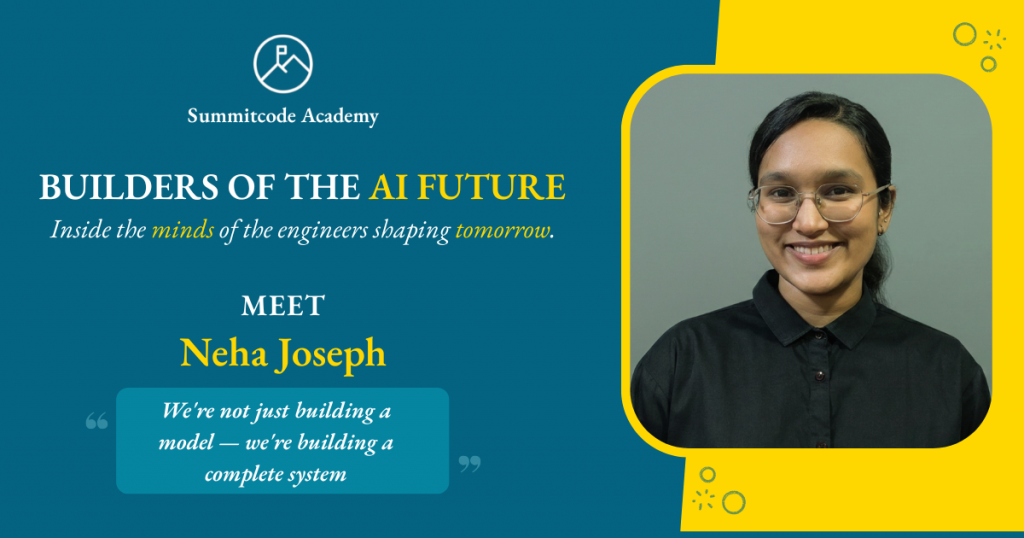
Some engineers are drawn to what AI can do. Neha Joseph wants to understand how it thinks.
A final-year Computer Science student at VIT-AP University, Neha didn’t come to the SummitCode AI Engineering Internship looking for a resume line. She came looking for architecture — the kind you can only find when you’re deep inside a real AI system, watching its components talk to each other, fail, adapt, and improve.
Today, she’s building exactly that. We sat down with Neha to hear what it’s like to go from machine learning theory to engineering autonomous AI systems in production.
Before SummitCode: From Personal Projects to Real Systems
Before joining SummitCode, Neha was already going further than most students would. Alongside her degree, she was spending her time building personal AI projects, exploring machine learning systems, and pushing into backend development — not because the curriculum required it, but because she was genuinely curious about what lay beyond the models.
“What attracted me to this internship was the opportunity to work on real-world AI systems rather than just theoretical machine learning models,” she explains.
The gap between academic AI and production AI is wider than most people realize. Neha had already sensed it. SummitCode gave her the chance to cross it.
The Product: Wordiva.ai — The AI That Markets for You
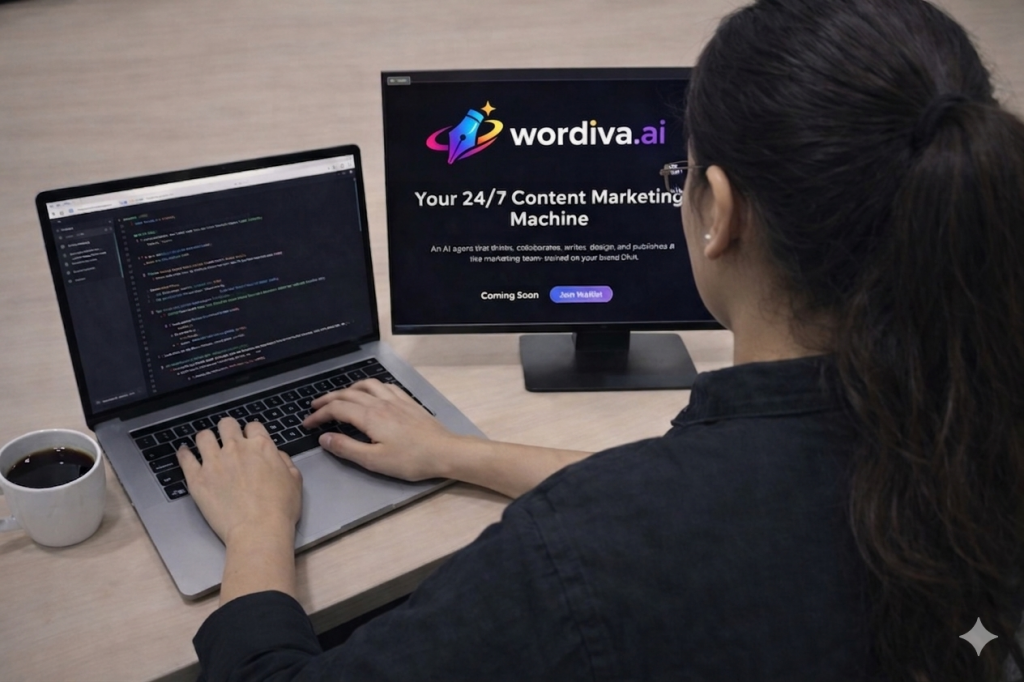
Wordiva.ai is an AI Content Marketing Agent built at the SummitCode Venture Studio — and Neha is engineering its intelligence from the inside.
The idea is both ambitious and practical: instead of a marketing team manually researching a brand, planning content, writing blog posts, sourcing images, and hitting publish, Wordiva’s AI automates that entire pipeline — while still keeping humans in the review loop before anything goes live.
“The system is designed for companies or marketing teams that want to streamline their content creation process,” Neha says.
It’s not a tool. It’s an autonomous system. And building it requires thinking at a level most CS programmes never reach.
The Hard Problems: Teaching AI to Understand a Brand
Every ambitious system has its ugly problems. For Neha, the first serious challenge was one of the most fundamental: how do you extract meaningful, structured brand information from the web when most websites are cluttered with noise?
Brand tone, messaging, visual identity — this information exists everywhere on a company’s website, buried inside inconsistent HTML, marketing fluff, and technical junk. Getting the AI to understand a brand, rather than just collect data about it, required serious engineering.
“Websites usually have a lot of junk or messy content, making it hard to find information like brand messages, tone, and visuals,” she explains.
Her team’s solution was systematic: Playwright for automated web browsing, BeautifulSoup for structured content extraction, and careful data filtering to build a clean, reusable knowledge base the AI could later draw from for content generation.
“The brand information was really important, so we focused on extracting brand messages and brand tone. This helped us build a cleaner knowledge base.”
It’s the kind of unglamorous, foundational work that separates toy projects from production systems — and the moment Neha knew she was doing something real.
The Breakthrough: When Semantic Search Changed Everything
Ask Neha which technology surprised her most, and the answer is immediate: vector databases.
Coming from a background in traditional keyword-based search, the shift to semantic search was a genuine revelation — not just as a technique, but as a new way of thinking about how AI retrieves information.
“Vector databases help the system understand the meaning of what you’re searching for — it’s different from searching for keywords. This means AI can retrieve information based on context.”
This is the engine behind Wordiva’s intelligence. Rather than matching strings, the system understands intent. Rather than finding pages, it finds meaning. That’s what makes the content it generates feel on-brand rather than generic — and it’s Neha’s team that built the infrastructure to make it work.
Combined with Retrieval-Augmented Generation (RAG), AI agent frameworks, and custom data pipelines, the stack Neha is working across is a genuine cross-section of modern AI engineering — not the sanitized, academic version, but the real thing.
The Real Education: What University Doesn’t Architect

Neha is precise about what makes this experience different from anything her degree has given her.
“The majority of AI projects at universities concentrate on experimenting with algorithms or training models. Here, we are learning how to construct entire AI systems — including automation, workflow orchestration, knowledge storage, and data pipelines.”
The distinction matters. Training a model is one skill. Orchestrating multiple AI components into a cohesive, reliable, production-grade system is another discipline entirely. One is academic. The other is engineering.
“We are creating a complete system that combines several AI components rather than just a model — which feels much more like real-world engineering.”
The Moment It Became Real
Every engineer has a moment when they stop feeling like they’re practicing and start feeling like they’re building. For Neha, it came when the pipeline finally worked.
“One moment that stood out was when we successfully built the pipeline that collects brand data from a website and processes it into structured information.”
Watching the system automatically gather brand information, process it, and store it in a form that could be reused across the entire product — that was the shift. Not a demo. Not a prototype. A production component.
“Seeing the system automatically gather brand information and store it in a way that can be reused later made it feel like we were building a real production component rather than a small academic project.”
The Environment: Mentorship That Teaches You to Think
What Neha values most about the SummitCode environment isn’t the access to cutting-edge tools — it’s the way the mentors approach problems.
“The mentors help us think more like engineers by encouraging us to comprehend the ‘why’ behind specific architectural choices, rather than merely providing instructions.”
Daily scrum meetings keep the team aligned, ideas flow openly, and every architectural decision gets interrogated — not to second-guess, but to build understanding. It’s a culture that produces engineers who don’t just implement solutions, but who can reason about why those solutions are right.
What Comes Next
For Neha, this internship isn’t just a credential — it’s a redefinition of what she wants to build.
“This experience is helping me move from simply learning AI concepts to engineering AI systems that can operate autonomously.”
The technologies she’s now fluent in — RAG systems, vector databases, agent workflows, and autonomous pipelines — are precisely the technologies that define modern AI engineering roles. The doors it opens lead to AI platforms, large-scale autonomous systems, and the kind of infrastructure-level work that shapes how intelligent products are built.
Her Message to the Next Builder
If you’re curious about AI but still haven’t taken the step, Neha’s advice is clear and direct:
“If you want to move beyond theory and actually learn how AI systems are built in practice, this internship is a great opportunity. You get to work on real architecture, explore emerging technologies like agentic AI, and build something that resembles real industry systems.”
“If you’re curious about AI and enjoy solving complex engineering problems, it’s definitely worth applying.”
Most CS students train models.
— SummitCode (@SummitCodeLLC) April 7, 2026
Neha Joseph builds the systems around them
AI Intern at SummitCode—breaking down how to go from uni AI projects to shipping autonomous systems in production.
Watch. Then apply👇
📩 https://t.co/WXRqVi9MVs#AIEngineering #AIInternship #AgenticAI pic.twitter.com/y6Qiw6wT06
Neha Joseph is an AI Engineering Intern at SummitCode, contributing to Wordiva.ai — an AI Content Marketing Agent built at the SummitCode Venture Studio. Connect with her on LinkedIn.
Ready to build real AI systems? Explore the SummitCode AI Engineering Internship →